
A 140 lm/W LED street light produces 140 lumens of luminaire output for each watt of input power under the stated test conditions. It is an important efficiency metric, but it does not predict road illuminance by itself. Optics, pole geometry, light loss, ambient conditions and the required uniformity determine how much of that output becomes useful light on the road.
Key facts for project buyers
- Confirmed OD-027 luminaire efficacy is 140 lm/W.
- The listed 50W, 100W and 150W outputs are 11,200 lm, 22,400 lm and 33,600 lm.
- OD-027 provides T3, T4 and T5 optical distribution options.
- IP66, aluminum construction and AC100-305V input are confirmed across the range.
- Lifecycle analysis should combine energy, photometric performance, maintenance and controls.
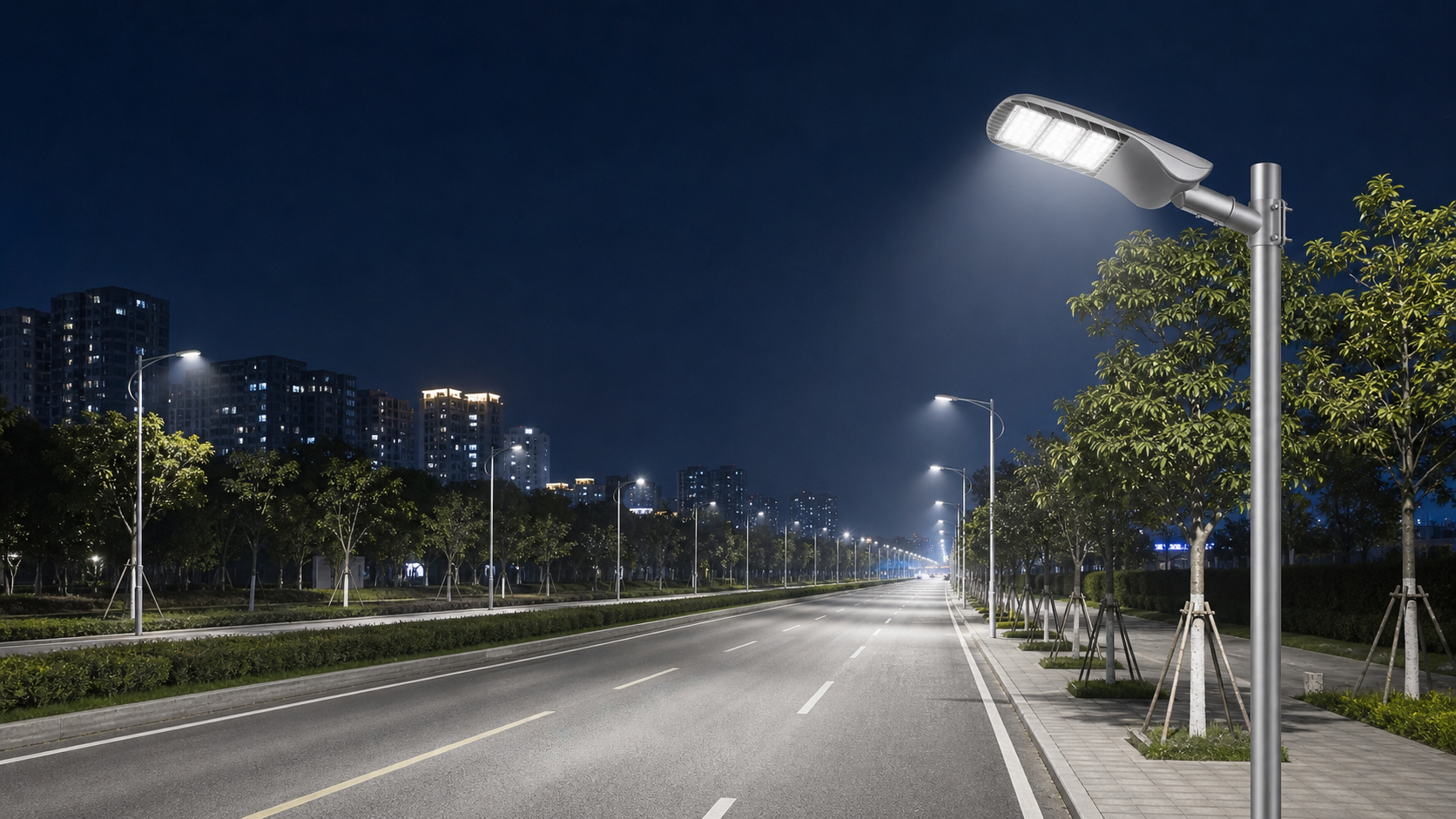
How is luminaire efficacy calculated?
Luminaire efficacy divides total luminaire lumens by input watts. At 140 lm/W, a 100W luminaire corresponds to 14,000 lumens in a simple calculation. The confirmed OD-027 product table lists 22,400 lm for its 100W configuration, so buyers should request the applicable test report and clarify whether all displayed values use the same measurement basis.
This illustrates an important procurement rule: do not combine a headline efficacy and a separate lumen table without confirming the exact configuration and test conditions. Ask for a photometric file and electrical report for the model being quoted.
Why high efficacy does not guarantee a good road layout
Road users experience illuminance, uniformity and glare—not the lumen value printed on a datasheet. A highly efficient luminaire with the wrong optical distribution can place too much light near the pole or outside the carriageway.
OD-027 material lists T3, T4 and T5 beam options. The appropriate distribution depends on road width, pole setback, mounting height, outreach and spacing. Model the actual geometry and evaluate average illuminance, minimum illuminance, uniformity and glare together.
- Use the IES or LDT file for the exact wattage and optic.
- Include maintenance and light-loss factors in the calculation.
- Confirm tilt angle and pole-arm geometry.
- Compare useful road performance at equal design criteria.
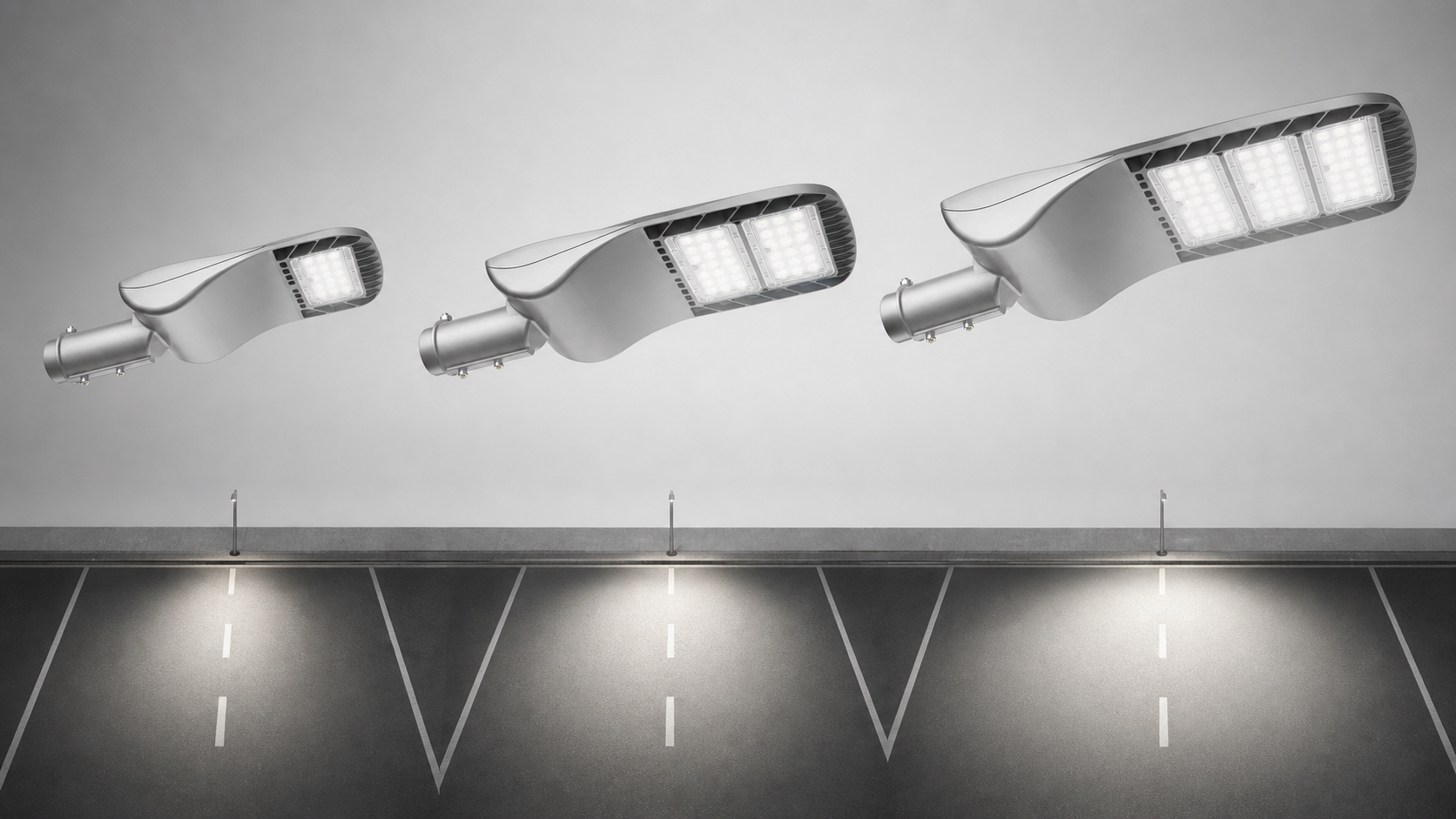
How can 140 lm/W affect project energy use?
For a preliminary comparison, multiply luminaire input power by fixture quantity and annual operating hours. One hundred 100W fixtures operating 4,100 hours per year use about 41,000 kWh before control savings. A different proposal should be compared at the same lighting performance and schedule.
Controls can add savings through dimming during low-traffic periods, but the driver and control interface must be specified. Do not claim control savings unless the operating profile and dimming levels are agreed.
What belongs in a municipal efficacy specification?
State whether efficacy is initial luminaire efficacy and identify the test standard, ambient temperature, CCT, CRI, driver and optical configuration. Require a tolerance or minimum value rather than relying on a marketing headline.
Also specify lumen maintenance, warranty, surge protection, IP rating and housing requirements. These affect lifecycle performance even though they do not appear in the lm/W calculation.
- Minimum luminaire efficacy and tested input power.
- Initial lumens for each quoted wattage.
- CCT, CRI, optic and photometric-file reference.
- IP rating, surge protection and operating-temperature range.
- Warranty, driver access and replacement-part policy.
How should lifecycle cost be compared?
Calculate purchase, installation, electricity, planned maintenance, expected driver replacement and control-system costs over a common analysis period. Use the same electricity price escalation and discount assumptions for each proposal.
A slightly higher initial price can be justified by verified optical performance, lower energy use or easier maintenance. Conversely, an efficiency claim without matching photometric and reliability data should not dominate the decision.
Confirmed product data
| Confirmed item | 50W | 100W | 150W |
|---|---|---|---|
| LED quantity | 80 pcs | 160 pcs | 240 pcs |
| Total luminous flux | 11,200 lm | 22,400 lm | 33,600 lm |
| Dimensions | 408 × 230 × 105 mm | 509 × 230 × 105 mm | 601 × 257 × 108 mm |
| Gross weight | 3.1 kg | 3.6 kg | 4 kg |
| IP rating | IP66 | IP66 | IP66 |
| Input voltage | AC100-305V | AC100-305V | AC100-305V |
| Color temperature | 3000-6500K | 3000-6500K | 3000-6500K |
Project recommendation
Treat 140 lm/W as one verified input to the design. Request the exact OD-027 photometric file, test data and proposed optic, then compare energy use only after every option meets the same road-lighting criteria.
View the OD-027 140 lm/W LED Street Light product page and confirmed specifications.
Frequently asked questions
Is 140 lm/W good for an LED street light?
It is a strong luminaire-efficacy level when verified for the quoted configuration, but optical distribution, road performance and reliability must also meet the project requirement.
Does twice the wattage always produce twice the road lux?
No. Lumens may scale with power, but road lux also depends on optics, mounting height, spacing, tilt and surface geometry.
What is the difference between lumens and lux?
Lumens describe total light output. Lux describes illuminance on a surface, equal to lumens per square meter. Road projects are designed around surface performance.
Which OD-027 optic should a municipality choose?
Choose among the listed T3, T4 and T5 options through a photometric simulation using the actual road and pole geometry.


