
An adjustable LED street light can simplify a retrofit when existing pole arms, wall brackets or mounting angles vary across the site. The adjustable joint helps align the luminaire with the target road surface without redesigning every support. It does not eliminate engineering checks: bracket strength, insertion depth, cable routing, wind load and photometric aiming must still be verified.
Key facts for project buyers
- OD-023 is available in confirmed 50W, 100W, 150W and 200W options.
- The product material confirms IP66 protection and 165-265V input.
- An adjustable mounting angle can help reuse existing pole or wall interfaces.
- Aiming changes alter light distribution, glare and uniformity, so simulations should use the intended tilt.
- Mechanical surveys should be completed before ordering retrofit quantities.
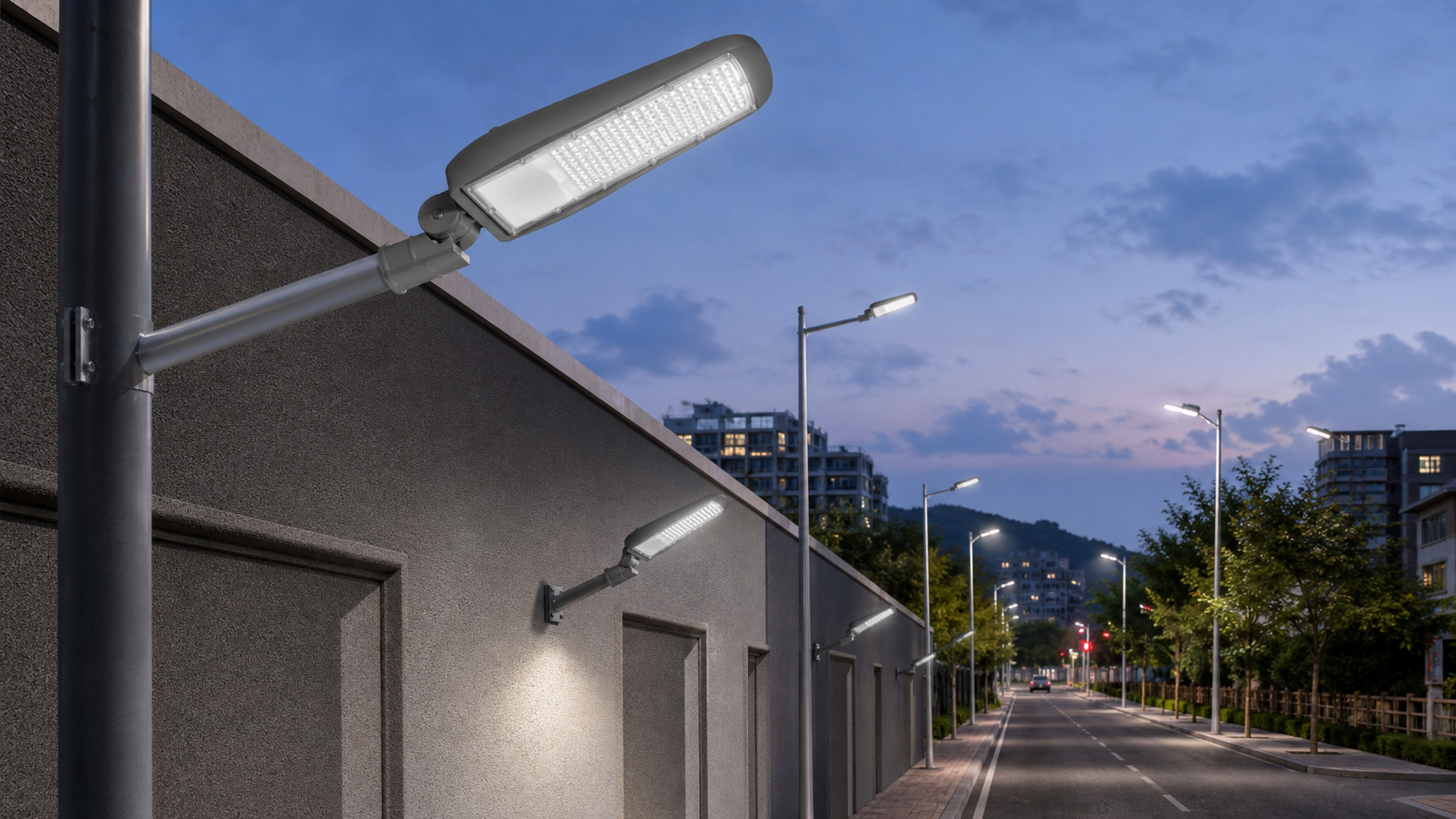
What problem does an adjustable mounting joint solve?
Older roads often contain a mix of horizontal arms, up-tilted arms, short outreach brackets and wall-mounted supports. A fixed-angle fixture may point too high or too low when fitted to these existing structures. An adjustable joint creates a controlled way to align the luminaire body with the designed optical orientation.
This flexibility is especially useful when a retrofit must avoid pole replacement or extensive civil work. It can reduce the number of special brackets required, but the approved adjustment range and locking method must be confirmed for the actual installation.
Why aiming angle must be included in the lighting calculation
Tilting a luminaire changes where the beam reaches the road. Excessive upward tilt can increase glare, send light beyond the target and reduce useful uniformity. A downward angle can shorten the throw and create bright areas near the pole.
The photometric calculation should therefore use the proposed mounting height, outreach, setback and tilt angle. If several pole-arm geometries exist, model the main groups rather than assuming one universal arrangement.
- Record pole height, arm length, arm diameter and existing tilt.
- Photograph the joint, cable exit and available insertion depth.
- Confirm the required luminaire orientation before final bracket selection.
- Check that field adjustment can be locked against vibration and wind.
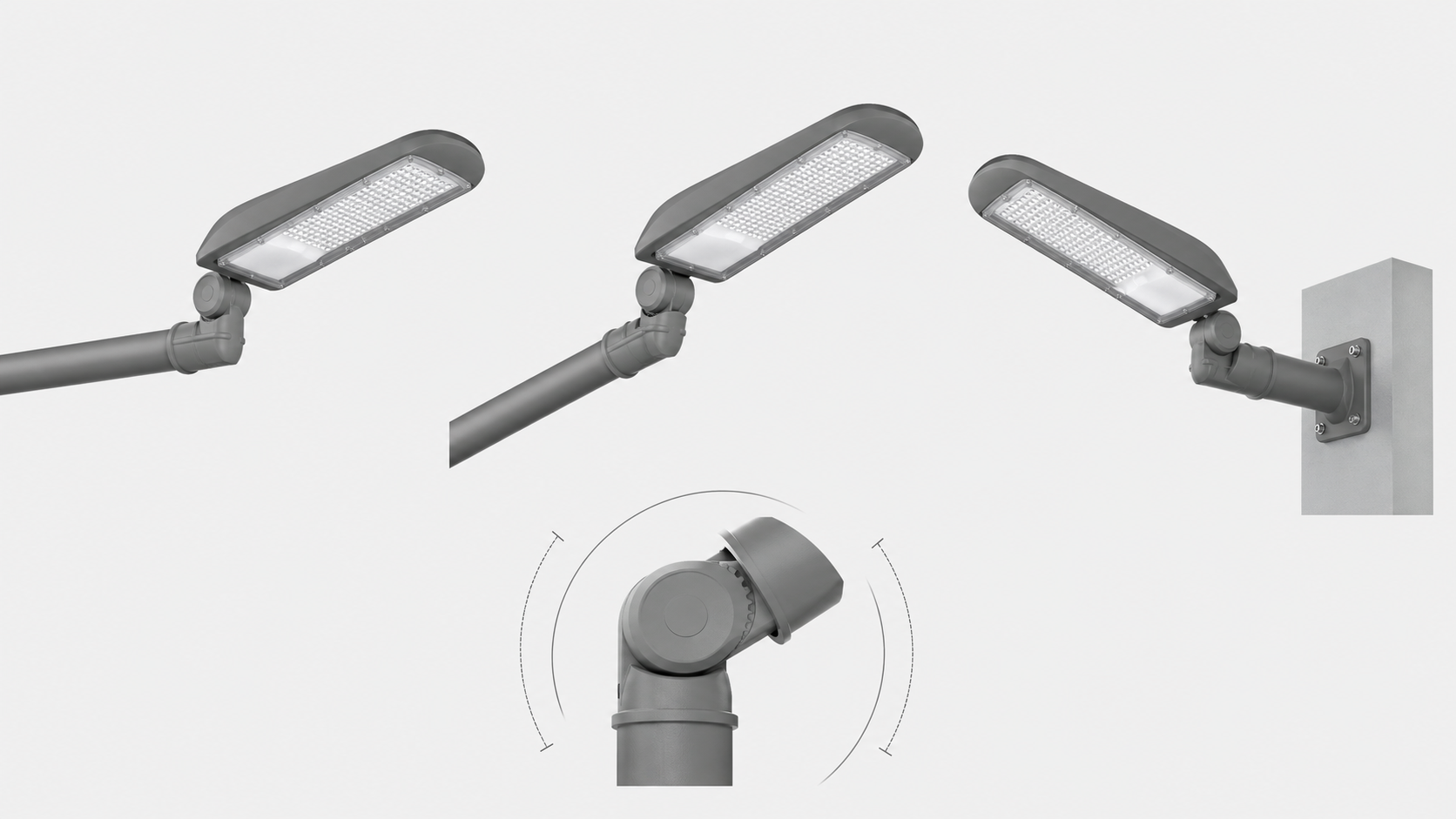
How should power be selected for a retrofit?
The OD-023 family offers 50W, 100W, 150W and 200W choices, but the old fixture wattage is not a reliable one-to-one selection rule. LED optics, efficacy, mounting geometry and the target standard can produce a different result from the legacy lamp.
Use the existing wattage only as background information. The replacement proposal should show the calculated average and minimum illuminance, uniformity, glare considerations and input power for the proposed OD-023 configuration.
Which mechanical and electrical checks prevent site delays?
Measure the outside or inside diameter of the pole arm according to the mounting interface. Confirm insertion depth, fixing-bolt position, cable path and whether an adapter is required. Check the condition of old arms and brackets; a flexible luminaire joint cannot compensate for a corroded support.
The confirmed OD-023 input is 165-265V. Project engineers should also verify circuit voltage, earthing, protective devices, switching method and surge requirements. IP66 protection should be maintained through correct cable entry and enclosure handling.
- Pole-arm or wall-bracket dimensions.
- Luminaire weight and project wind-load requirement.
- Cable gland, cable diameter and earthing arrangement.
- Supply voltage, surge protection and control method.
- Access method for installation and future maintenance.
When does adjustability deliver the most value?
Adjustability is most valuable on mixed legacy infrastructure, wall-mounted access roads, campuses, industrial estates and phased municipal upgrades. It provides one product platform for several common mounting conditions while keeping the visual appearance consistent.
For a new road with standardized poles, a fixed optimized geometry may be equally effective. The project goal is not maximum adjustability; it is a secure mechanical installation and the correct optical orientation.
Confirmed product data
| Confirmed item | OD-023 data |
|---|---|
| Power options | 50W / 100W / 150W / 200W |
| Input voltage | 165-265V |
| IP rating | IP66 |
| Rated lifespan | 50,000 hours+ |
| Installation | Adjustable angle |
| Applications | Roads, parks, highways and stadium areas |
Project recommendation
Before selecting OD-023 for a retrofit, survey at least a representative sample of pole arms and wall brackets. Send dimensions, photos, mounting height, spacing, target lighting level, voltage and quantity so the adjustable joint and wattage can be evaluated together.
View the OD-023 Adjustable LED Street Light product page and confirmed specifications.
Frequently asked questions
Can an adjustable LED street light fit every existing pole arm?
No. Adjustment helps with orientation, but arm diameter, insertion depth, bolt positions, cable routing and structural condition must still match the luminaire or an approved adapter.
Does tilting a street light change the lux level?
Yes. Tilt changes beam placement, uniformity and glare. The intended angle should be included in the photometric calculation.
Should replacement wattage match the old lamp wattage?
Not automatically. Compare calculated road performance, optics and input power rather than using a one-to-one wattage rule.
Is OD-023 suitable for wall mounting?
The product material shows adjustable installation for pole and wall-type applications, but the wall bracket and fixings must be engineered for the actual structure and wind load.


