
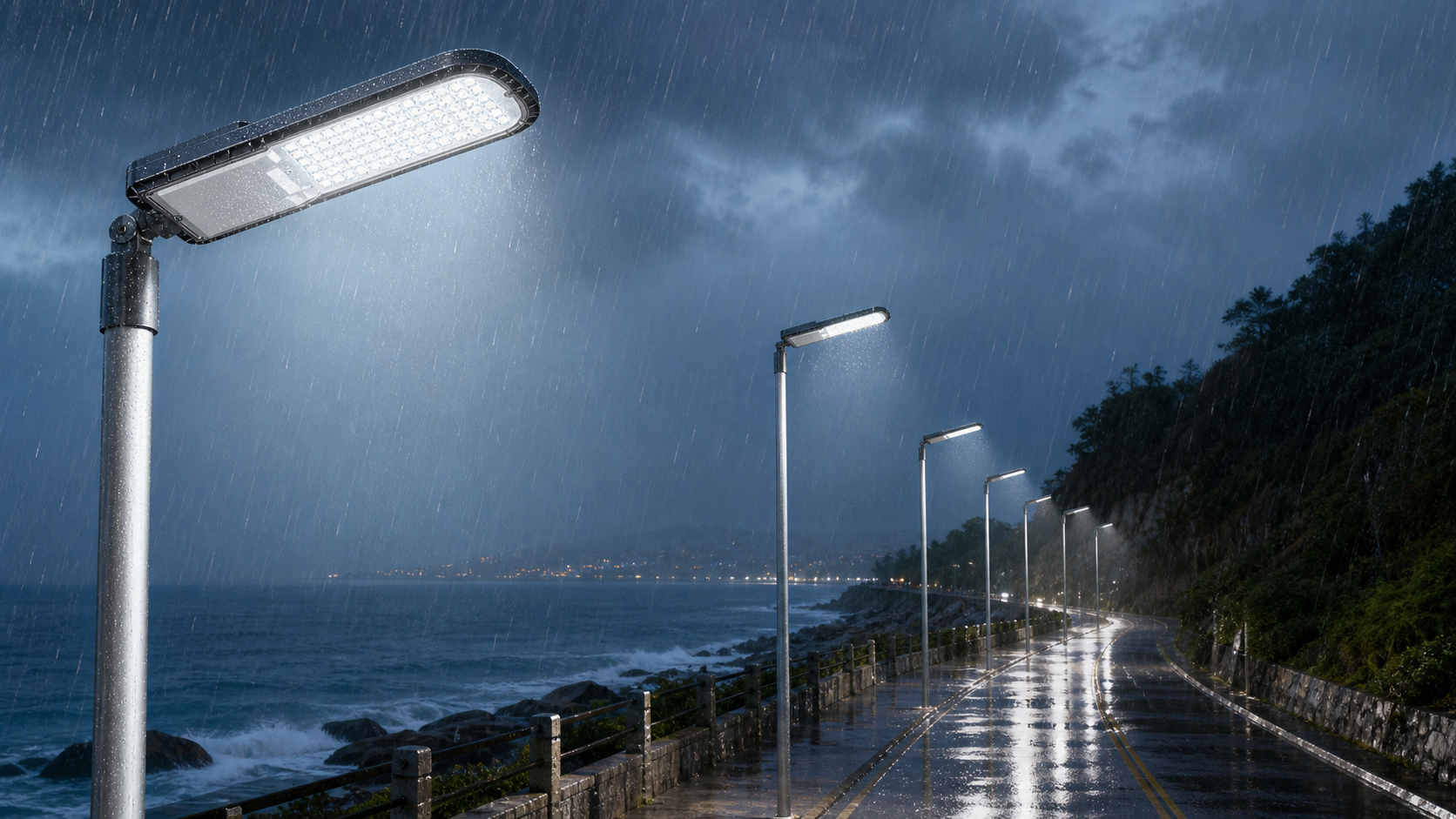
For coastal or high-rainfall roads, an IP66 LED street light is a strong starting requirement because it is dust-tight and protected against powerful water jets under the relevant test conditions. A reliable project specification should also cover corrosion resistance, cable-entry sealing, surge protection, drainage, installation quality and maintenance access. IP rating alone does not address salt spray or electrical transients.
Key facts for project buyers
- The OD-018 range provides 50W, 100W, 150W, 200W and 300W configurations.
- Confirmed input voltage is AC85-265V across the five listed sizes.
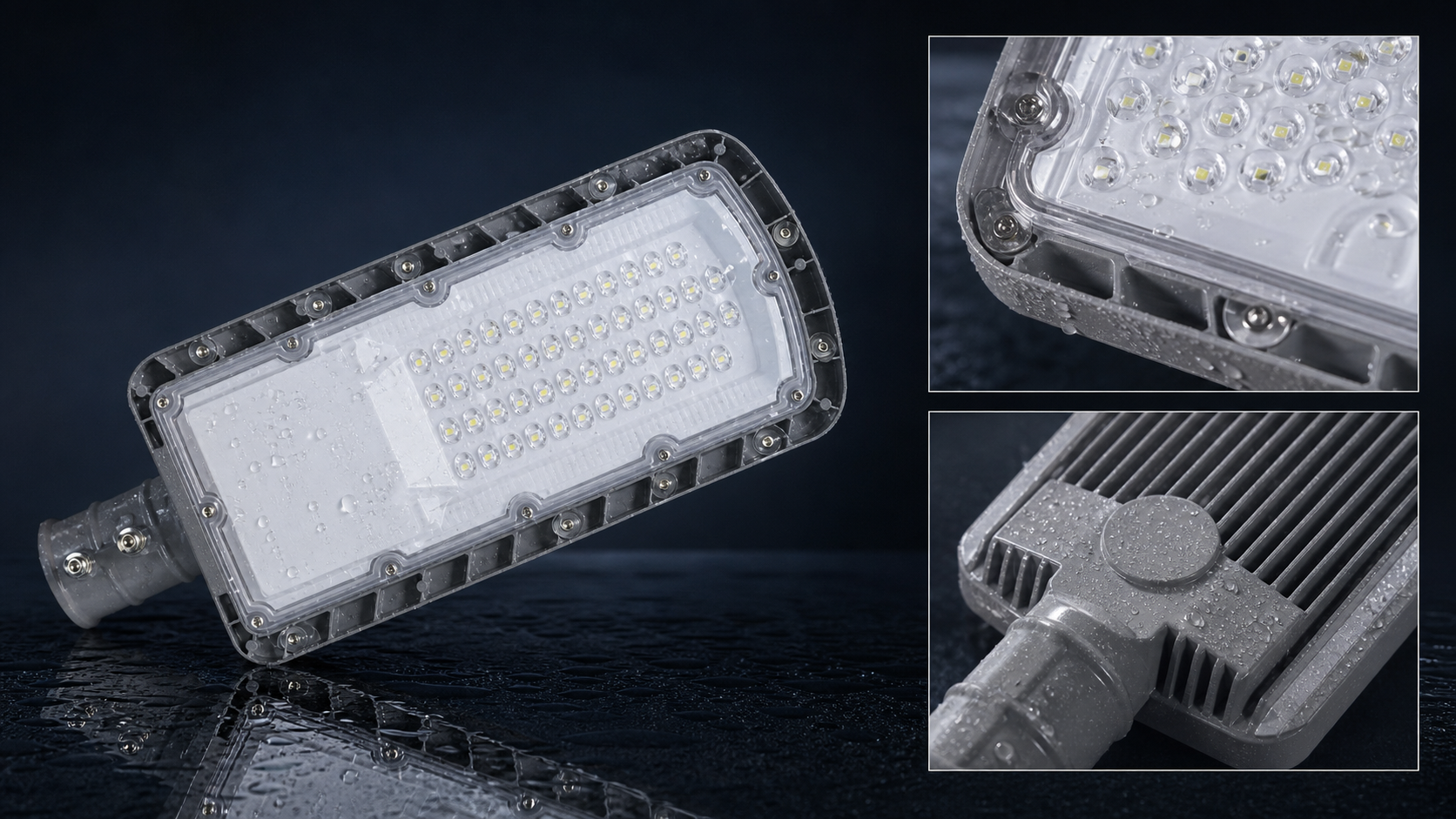
- The housing uses aluminum with clear polycarbonate optics.
- IP66 is a water- and dust-ingress rating; it is not automatically a salt-spray certification.
- Coastal quotations should state coating, fastener, cable-gland and surge requirements.
What does IP66 mean in a road-lighting specification?
The first digit, 6, indicates dust-tight protection. The second digit, 6, indicates protection against powerful water jets under the defined test method. For exposed roads, ports, resorts and rainy regions, this offers a higher water-ingress threshold than IP65.
However, buyers should avoid reducing the whole specification to one code. Water can enter through an incorrectly installed cable gland or damaged gasket even when the luminaire design is rated IP66. Installation instructions, gland size, cable diameter and torque control remain part of the system.
Why coastal exposure needs more than an IP rating
Coastal air introduces salt particles that can accelerate corrosion on housings, brackets, fasteners and electrical contacts. IP66 describes enclosure ingress protection, not long-term resistance to salt spray. A coastal tender should therefore state the required coating system, fastener material, pretreatment and any salt-spray test duration required by the project.
Wind-driven rain also increases the importance of mounting orientation and drainage. Avoid installation details that allow water to pool around cable entries or brackets. After commissioning, inspect seals, screws and coating damage as part of the maintenance plan.
- Request coating and salt-spray information for marine or near-shore sites.
- Confirm stainless or protected fasteners where the project requires them.
- Specify sealed cable glands matched to the actual cable diameter.
- Include inspection of gaskets and housing damage in maintenance procedures.
How should wattage be selected from 50W to 300W?
The OD-018 family spans five housing sizes and power levels. The correct option depends on road width, mounting height, pole spacing, optical distribution and the required average and minimum illuminance. Higher wattage should not be used as a substitute for a photometric study.
For procurement, provide the road cross-section and pole geometry. The supplier can then match a fixture size and optical distribution to the target. The confirmed AC85-265V input range should also be checked against the local supply and project protection scheme.
What electrical risks are common in exposed road projects?
Long outdoor cable runs and lightning activity can expose LED drivers to transient overvoltage. Ask for the luminaire surge-protection configuration and coordinate it with the distribution board, grounding system and local lightning-risk assessment.
Voltage tolerance does not equal surge immunity. AC85-265V describes the operating input range shown for the OD-018, while surge protection is a separate performance requirement. State both in the purchase specification.
A practical coastal and rainy-site procurement checklist
A clear request for quotation reduces later substitutions and makes proposals easier to compare. Separate confirmed product data from project-specific options, and require suppliers to identify any deviations.
Before shipment, agree on inspection documents, packaging protection and labeling. For coastal destinations, packaging should prevent coating damage and prolonged contact with moisture during transport and storage.
- Road dimensions, pole height, spacing and target lighting performance.
- Required IP rating, coating system and corrosion test expectation.
- Supply voltage, surge-protection level and grounding approach.
- Mounting interface, tilt, cable gland and connector requirements.
- Quantity, delivery schedule, warranty and spare-driver strategy.
Confirmed product data
| Power | Fixture size | Housing / optics | Input | IP rating |
|---|---|---|---|---|
| 50W | 415 × 170 × 70 mm | Aluminum + clear PC | AC85-265V | IP66 |
| 100W | 495 × 190 × 70 mm | Aluminum + clear PC | AC85-265V | IP66 |
| 150W | 595 × 210 × 80 mm | Aluminum + clear PC | AC85-265V | IP66 |
| 200W | 645 × 230 × 80 mm | Aluminum + clear PC | AC85-265V | IP66 |
| 300W | 730 × 250 × 80 mm | Aluminum + clear PC | AC85-265V | IP66 |
Project recommendation
Use IP66 as one part of the environmental specification. For coastal or high-rainfall projects, send the required wattage range, pole geometry, corrosion expectation, voltage, surge level, mounting interface and quantity so the OD-018 proposal can be checked as a complete system.
View the OD-018 IP66 LED Street Light product page and confirmed specifications.
Frequently asked questions
Is IP66 enough for a seafront road?
IP66 addresses dust and water ingress, but it does not by itself confirm resistance to salt spray. Coastal projects should also specify coating, fasteners, pretreatment and corrosion-test expectations.
What is the difference between IP65 and IP66 street lights?
Both are dust-tight. IP65 covers water jets, while IP66 covers more powerful water jets under the applicable test conditions. Site exposure and the full project specification should determine the required level.
Does AC85-265V input protect against lightning surges?
No. The input range and surge immunity are separate. Confirm the surge-protection device, grounding and distribution-board protection for the project.
Which OD-018 wattage is best for a coastal highway?
There is no universal wattage. Road width, pole height, spacing, optics and target illuminance must be modeled before selecting among the 50W to 300W options.


