
Choose LED street-light wattage from the required illuminance, mounting height, pole spacing, road width, optical distribution and maintenance target—not from wattage alone. As a planning starting point, lower-wattage fixtures suit smaller or lower-mounted areas, while 150W and 200W options are typically evaluated for wider roads, larger spacing or higher mounting. A photometric calculation should confirm the final choice.
Key facts for project buyers
- The OD-015 family provides 50W, 100W, 150W and 200W options in four housing sizes.
- All four confirmed configurations use an IP65 die-cast aluminum housing.
- The LED count rises with power: 72, 144, 216 and 252 pieces of 2835 LEDs.
- A project quote should include road width, pole height, pole spacing, supply voltage and the required lighting standard.
- Final wattage and spacing should be confirmed with a photometric layout rather than a watts-only rule.
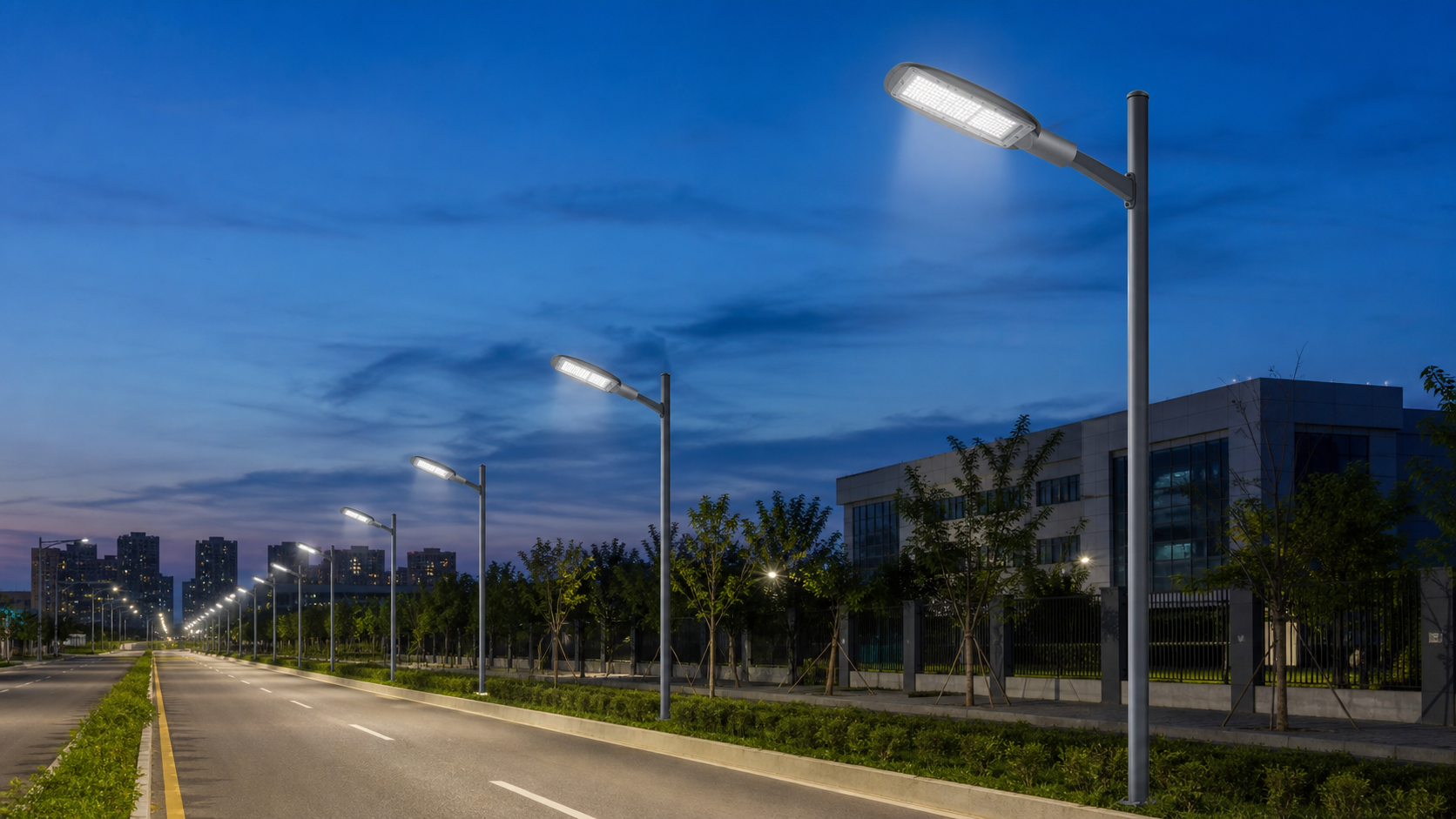
What is the quickest way to narrow the wattage range?
Start with the physical project. Record the carriageway width, number of lanes, sidewalk or shoulder width, pole position, mounting height and distance between poles. Then define the target average illuminance and uniformity. These inputs determine how much useful light must reach the road surface and how evenly it must be distributed.
For early budgeting, a 50W option may be considered for lower-mounted pathways, residential access roads or small outdoor areas. A 100W fixture is a common evaluation point for local roads and medium-area projects. The 150W and 200W sizes are more relevant when the road is wider, the poles are higher, the spacing is longer or the project needs more delivered lumens. These are screening ranges, not final design values.
- 50W: begin evaluation for lower mounting heights and smaller target areas.
- 100W: evaluate for local roads, community streets and medium outdoor areas.
- 150W: evaluate for wider roads, larger parking areas or increased pole spacing.
- 200W: evaluate for high-output road sections or higher mounting positions.
Why fixture size and LED count matter
The four OD-015 versions are not one housing driven at four arbitrary power levels. The confirmed product material shows progressively larger bodies and LED arrays. This gives project buyers a clear physical relationship between wattage, thermal area and LED quantity.
The 50W model measures 390 × 160 × 75 mm and uses 72 pieces of 2835 LEDs. The 100W model increases to 470 × 200 × 75 mm with 144 LEDs. The 150W model measures 530 × 220 × 75 mm with 216 LEDs, while the 200W version measures 600 × 250 × 75 mm with 252 LEDs. These differences should be included in pole-arm, wind-load, packaging and installation planning.
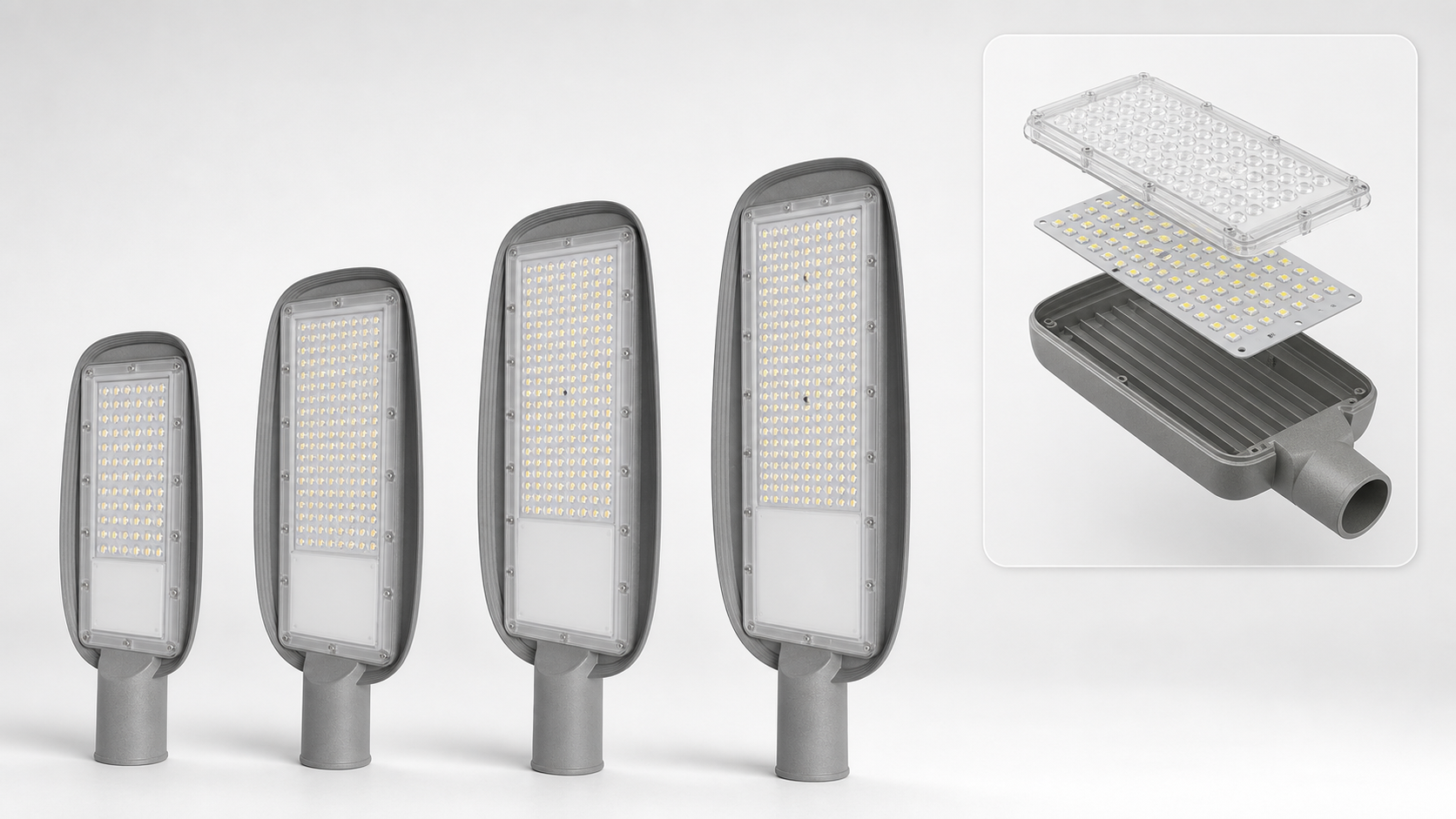
How do IP65 protection and die-cast aluminum affect outdoor use?
IP65 means the enclosure is dust-tight and protected against water jets under the applicable test conditions. It is suitable for many outdoor road-lighting projects when the fixture is installed and maintained correctly. IP65 does not replace proper cable glands, sealed connections, surge planning or site-specific corrosion protection.
The die-cast aluminum housing provides a rigid structure and a heat-dissipation path for the LED system. Good thermal management helps the LEDs and driver operate within their intended temperature range. Buyers should still confirm ambient-temperature limits, driver brand, surge-protection level and coating requirements for coastal, industrial or high-humidity sites.
What information should be sent for a reliable quotation?
A useful quotation is more than a unit price. Send the project geometry and performance target so the supplier can recommend wattage, optical distribution and quantity. If a lighting simulation is required, include a road cross-section or a simple dimensioned drawing.
For replacement projects, also provide the existing fixture wattage, measured pole spacing, mounting angle and photographs of the pole arm. This reduces the risk of choosing a fixture that is electrically suitable but mechanically inconvenient.
- Road or area dimensions and surface type.
- Pole height, spacing, arm length and tilt.
- Required illuminance, uniformity or applicable local standard.
- Supply voltage, surge environment and control requirements.
- Quantity, delivery schedule, packaging and OEM labeling needs.
How should buyers compare two wattage proposals?
Compare delivered lighting performance, not only nominal watts. Request the luminaire photometric file, a layout showing average and minimum illuminance, uniformity, glare considerations and input power. A lower-wattage proposal can be better when its optics place more light on the target area; a higher-wattage proposal can be necessary when mounting height or spacing creates a more demanding geometry.
Also compare installation compatibility, IP rating, housing material, warranty terms and spare-part strategy. A transparent proposal should explain why a wattage was chosen and which project assumptions were used.
Confirmed product data
| Confirmed item | 50W | 100W | 150W | 200W |
|---|---|---|---|---|
| Fixture size | 390 × 160 × 75 mm | 470 × 200 × 75 mm | 530 × 220 × 75 mm | 600 × 250 × 75 mm |
| LED source | 2835 / 72 LEDs | 2835 / 144 LEDs | 2835 / 216 LEDs | 2835 / 252 LEDs |
| IP rating | IP65 | IP65 | IP65 | IP65 |
| Housing material | Die-cast aluminum | Die-cast aluminum | Die-cast aluminum | Die-cast aluminum |
Project recommendation
Use the OD-015 range as a four-size platform, then confirm the exact wattage and optical layout against the project geometry. For faster engineering feedback, send pole height, spacing, road width, target lux level, voltage and quantity with the inquiry.
View the OD-015 LED Street Light product page and confirmed specifications.
Frequently asked questions
Is a 100W LED street light always suitable for a two-lane road?
No. Lane width, pole height, spacing, setback, optics, target illuminance and local standards can change the answer. A photometric calculation is the reliable way to confirm whether 100W is sufficient.
Can a 200W fixture replace a lower-wattage street light without changing the poles?
Electrical and mechanical compatibility must be checked first. Confirm the supply, protection devices, pole-arm diameter, fixture size, weight, tilt and wind-load requirements before replacement.
What does IP65 mean for the OD-015?
The confirmed OD-015 data specifies IP65 protection. This indicates dust-tight construction and protection against water jets under the relevant test conditions, provided the product is installed correctly.
Which project data is most important for an LED street-light quotation?
Pole height, pole spacing, road width, required lighting level, voltage, quantity and mounting details are the most useful starting inputs.


