Construction projects often need usable access roads, delivery lanes, temporary parking, security checkpoints, and staff routes before permanent electrical infrastructure is ready. For contractors and project owners in the United Arab Emirates, solar street lights can provide a flexible lighting option where trenching, cabling, or grid connection would conflict with changing site phases.
This guide explains how B2B buyers can specify solar street lights for UAE construction sites without relying on a generic wattage claim. The correct system depends on the route, operating schedule, solar resource, battery design, controls, mounting, and relocation plan.
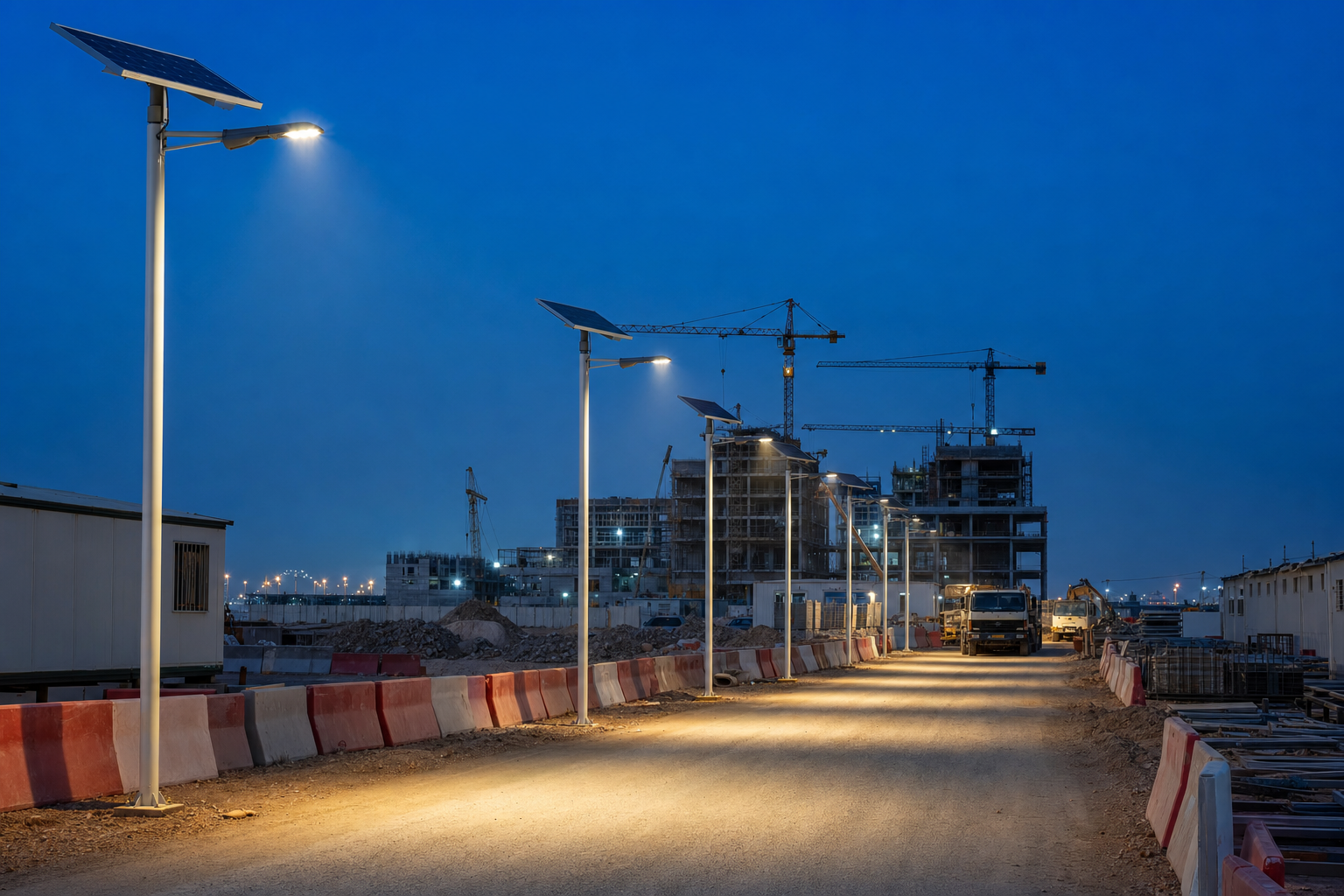
Start with a current site plan and identify what each route must support after dark. A main delivery road may carry trucks and heavy equipment, while a staff walkway, gate, storage compound, and temporary parking area have different visual tasks. Mark vehicle directions, turning points, crossings, barriers, gates, and camera positions before choosing poles.
Construction layouts change. Buyers should identify which poles will remain in place, which may move during later phases, and which routes will eventually receive grid lighting. This prevents the temporary system from blocking future excavation, drainage, utilities, or permanent road construction.
A solar street light is an energy system, not only a lamp head. The quotation should state LED power, operating hours, dimming stages, battery capacity, panel rating, controller logic, assumed system losses, and the design basis for low-sun or dusty periods. Buyers should ask for calculations that connect these values rather than accepting an unspecified claim about backup nights.
NREL's PVWatts tool estimates photovoltaic energy production from location and system inputs, while also warning that predictions contain assumptions and uncertainties. It is intended for grid-connected PV, so it does not replace an off-grid street-light battery calculation. However, its approach reinforces an important procurement principle: use credible local solar-resource inputs and disclose assumptions.
Panel output can fall when dust accumulates, and construction traffic can make soiling more severe than on a finished road. The design should provide safe access for cleaning and inspection without requiring workers to enter an active traffic lane. A realistic maintenance plan is more useful than assuming the panel will remain clean throughout the project.
High ambient temperatures can also affect batteries, LED drivers, and electronic controllers. Request the permitted operating-temperature range, enclosure details, battery location, thermal protection logic, and any derating information. Avoid enclosing heat-sensitive components where ventilation or service access is poor.
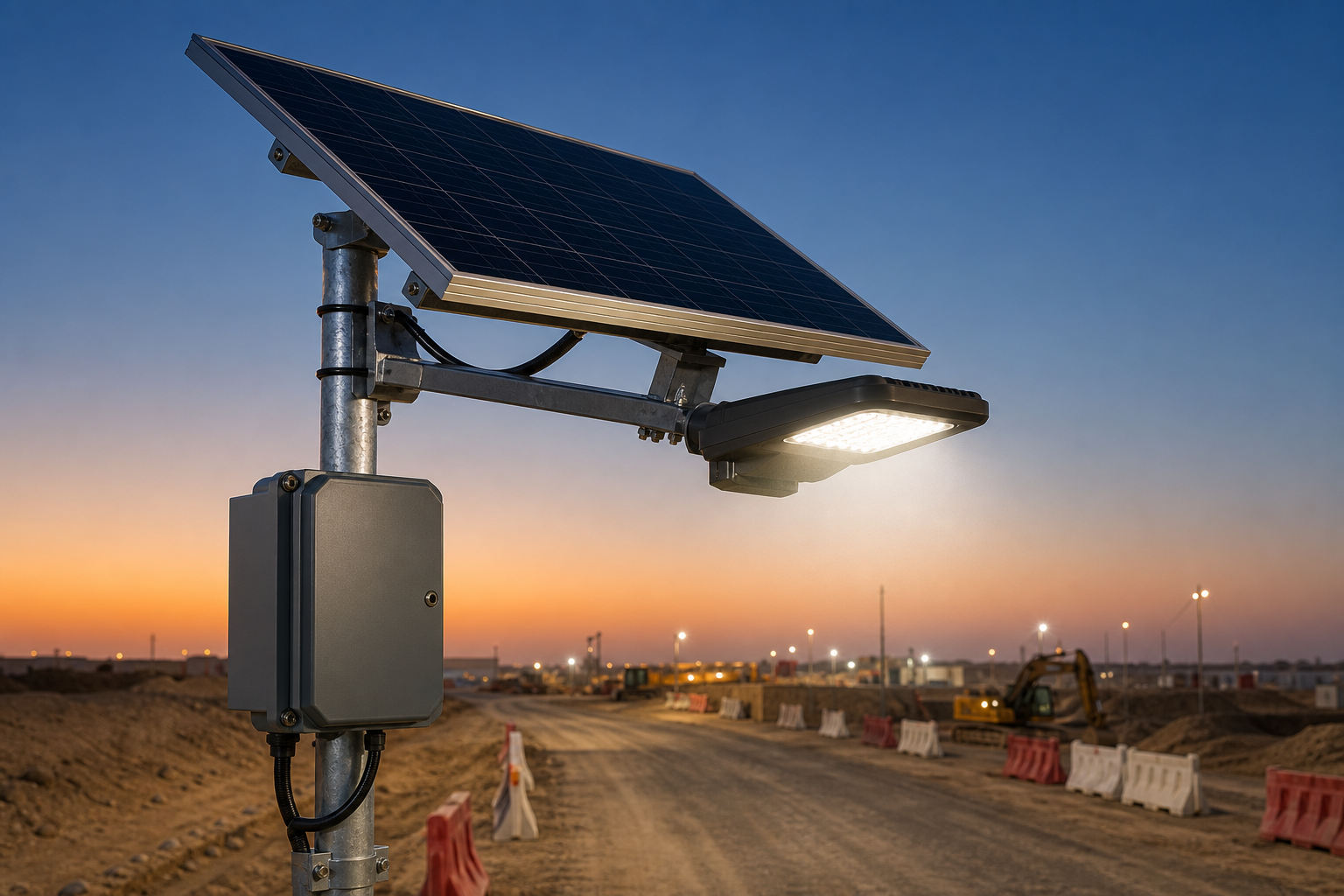
Nominal lumens do not show whether light reaches the required lane. Ask for a simple photometric layout that includes road width, pole spacing, mounting height, fixture tilt, light distribution, and maintained results. On construction routes, review bends, ramps, loading points, pedestrian crossings, and gatehouses rather than evaluating only a straight road segment.
The U.S. Department of Energy advises exterior-lighting buyers to gather accurate performance, cost, and reliability data. Its guidance also recognizes the value of lighting controls. Although local UAE requirements govern the project, this procurement logic is useful: compare documented luminaire performance and application design, not headline wattage alone.
Bright, poorly aimed fixtures can reduce visibility for drivers, equipment operators, guards, and neighboring road users. Use suitable roadway optics, controlled tilt, shielding where required, and pole positions that keep the light source out of critical sight lines. Camera locations should be reviewed because uncontrolled contrast can reduce useful CCTV detail.
The U.S. National Park Service outdoor-lighting principles recommend lighting only where needed, using shielding, applying controls, and selecting the minimum light level necessary for the task. These principles are not a substitute for UAE codes or a qualified lighting design, but they provide a practical review framework for spill light and operating schedules.
Construction activity may be high in the early evening and limited after a curfew. A staged schedule can provide full output during active deliveries, lower output during quiet periods, and responsive output near selected gates or work zones. The control sequence should be documented so that changes can be commissioned and verified.
Check how the controller handles low battery state, extended dust exposure, manual override, and power restoration. If remote monitoring is offered, clarify what is measured, how data is accessed, and whether the system can operate normally without a network connection.
Temporary does not mean structurally casual. Qualified professionals should verify foundations, wind loading, pole strength, brackets, fasteners, and clearances for the site. Poles should not obstruct truck turning paths, crane operations, future excavation, emergency access, or material storage.
If relocation is part of the project, define the approved base system, lifting method, disconnection procedure, replacement hardware, inspection steps, and who is responsible for recommissioning. Reusing damaged anchors or unverified brackets can create avoidable risk.
Factory-direct purchasing should produce one coordinated technical submittal. Lock the approved configuration before production and require written approval for substitutions, especially for batteries, drivers, controllers, optics, and mounting hardware.
The UAE Ministry of Energy and Infrastructure states that the updated UAE Energy Strategy 2050 promotes renewable energy, energy efficiency, research, and clean-energy investment. A construction-site lighting decision is much smaller than national energy planning, but the policy context supports careful evaluation of practical renewable-energy applications. Project suitability still needs to be assessed from site conditions, safety requirements, local approvals, and lifecycle cost.
No. They are strongest where there is adequate solar exposure, suitable pole space, predictable lighting demand, and a clear maintenance plan. Shaded areas, very high continuous loads, or routes with frequent layout changes may require a different or hybrid approach.
There is no universal number. The answer depends on the nightly energy load, dimming schedule, battery capacity, local solar resource, system losses, dust, temperature, and acceptable risk. Ask the supplier to show the calculation assumptions.
They can be designed for planned relocation, but foundations, lifting points, wiring, inspections, and recommissioning must be defined. Do not assume every permanent-style pole is safely relocatable.
Confirm the approved bill of materials, controller settings, battery and panel labels, brackets, fasteners, wiring, packing list, spare parts, installation instructions, and inspection records.
Guangzhou Vantone Science & Technology Co., Ltd. can review your UAE construction layout, access-road dimensions, operating schedule, solar exposure, pole constraints, and delivery plan for a factory-direct solar street-light proposal. Send the site drawing, project phase, voltage or off-grid requirements, quantity, and target delivery schedule to begin a technical review.


