Outdoor pickleball projects look simple on a site plan, but the lighting brief has to balance fast ball tracking, player comfort, neighboring properties, energy use, and long-term maintenance. For developers, distributors, clubs, municipalities, and contractors, the right procurement question is not simply how many watts a fixture uses. It is whether the complete system puts controlled, uniform light on the playing area.
This guide explains how to specify outdoor LED sports lighting for pickleball courts in the United States without relying on unverified product claims or a one-size-fits-all layout.
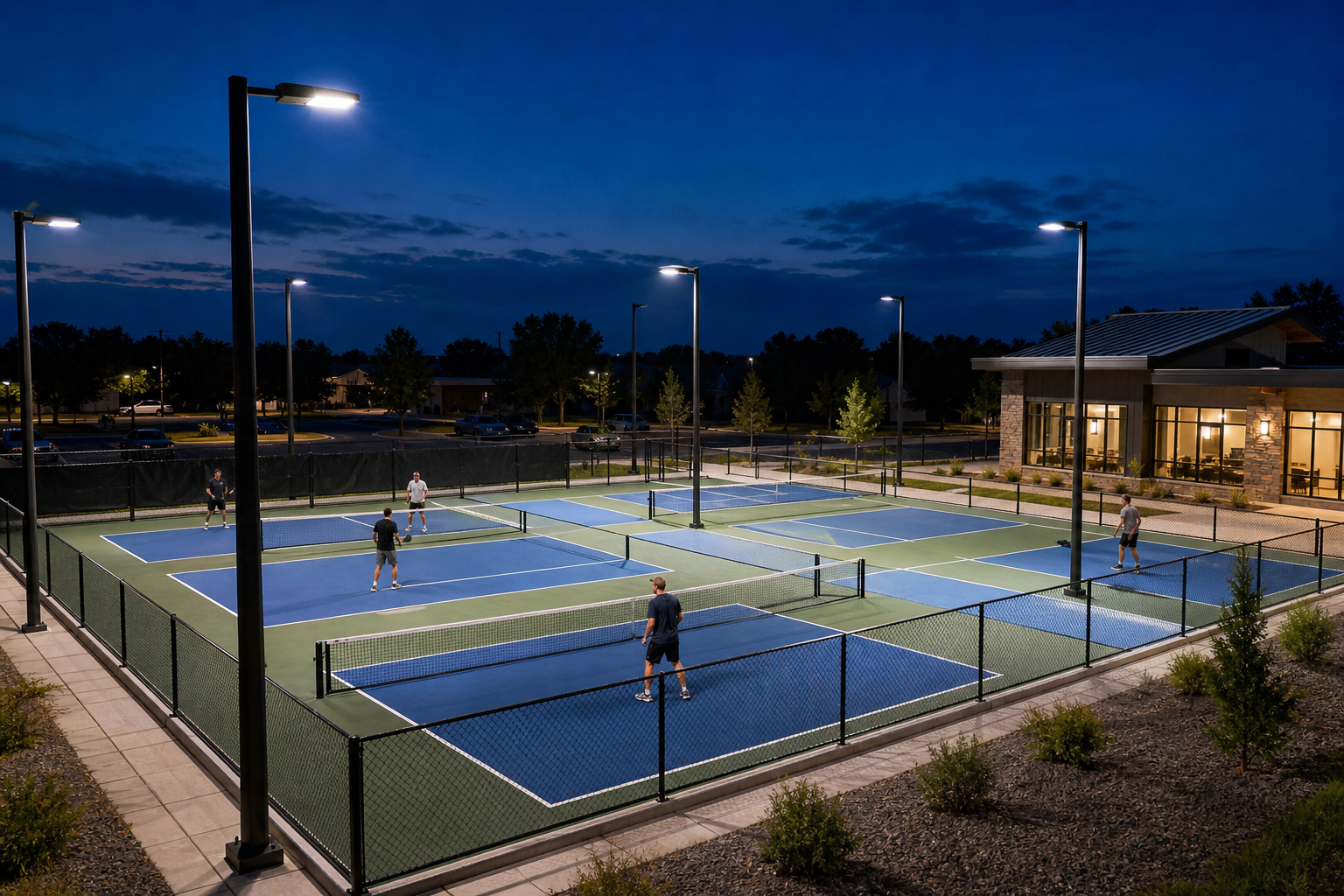
Define whether the courts will serve casual recreation, clubs, tournaments, schools, hospitality projects, or mixed-use communities. The required visual conditions can differ by competition level, spectator needs, operating hours, and surrounding land use. ANSI/IES RP-6-24 is the current IES recommended practice for sports and recreational areas, and its scope includes outdoor sports, illuminance recommendations, uniformity, aiming, and field measurement. The IES notes that the edition includes enhanced pickleball guidance.
USA Pickleball recommends high-quality lighting that avoids shadows and glare. Its construction guidance also emphasizes uniform distribution and locating poles outside the playing area. Buyers should therefore request a project-specific lighting calculation instead of selecting fixtures from nominal wattage or lumen output alone.
A useful supplier submittal should show the court geometry, pole coordinates, mounting heights, luminaire quantities, aiming points, maintained light levels, uniformity, and calculation grid. Include fences, nearby buildings, parking, walkways, trees, and property boundaries because these objects affect placement and spill-light risk.
Ask the supplier to identify the photometric file and luminaire configuration used in the calculation. If shields, visors, or different optics are required, they should appear in both the bill of materials and the model. A rendering can help stakeholders understand the design, but it should not replace numerical calculations.
Pickleball players frequently look upward to track the ball, making direct glare particularly disruptive. Deep optical shielding, suitable beam control, sensible mounting height, and careful aiming should work together. More light is not automatically better if bright sources enter a player's normal view or create high-contrast patches.
The U.S. National Park Service outdoor-lighting principles recommend lighting only where needed, using recessed or fully shielded fixtures, applying controls, and using the minimum light level necessary for the task. Although a sports facility has different needs from a park, these principles are useful when reviewing light trespass, upward light, and late-night operation. Local zoning and nuisance-light requirements still need to be checked for the specific site.
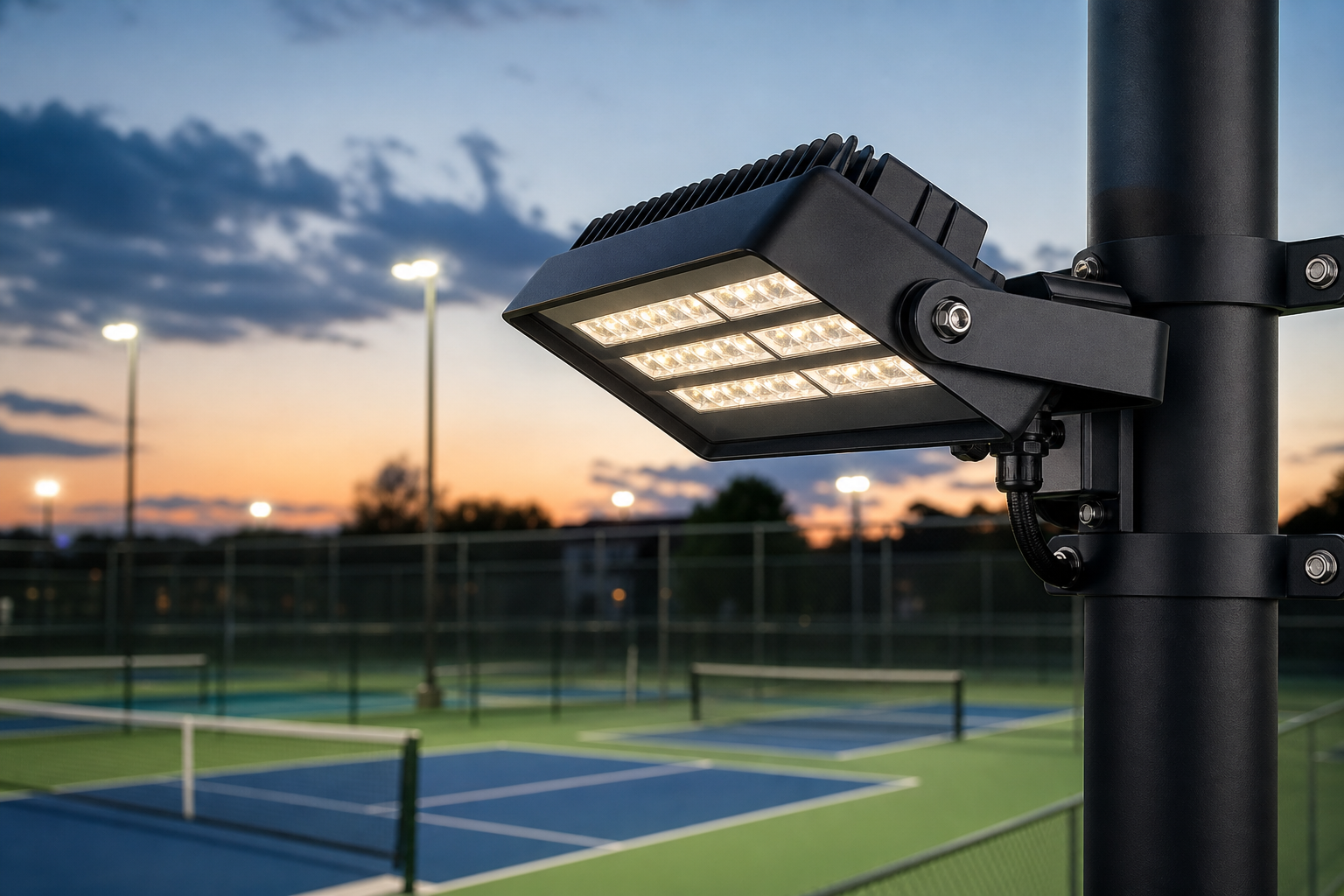
For an apples-to-apples comparison, request an LM-79 photometric report or equivalent independent test documentation for the offered configuration, along with electrical data, driver details, surge-protection information, operating-temperature range, ingress-protection documentation, and relevant warranty terms. Do not assume that every variant in a product family has identical output or optics.
The U.S. Department of Energy advises buyers to gather accurate, relevant data on product performance, cost, and reliability. Its exterior-lighting guidance also highlights the controllability of LED systems. A technically complete offer should connect test documentation to the exact ordering code, rather than attaching generic brochures.
Multi-court venues can reduce unnecessary runtime by zoning courts separately. Consider scheduling, manual override, vacancy response, staged output, and an automatic curfew where appropriate. The control strategy should be documented in the electrical design and commissioning plan so that facility staff understand normal, event, and shutdown modes.
Controls should not compromise player safety through abrupt switching or poorly chosen dimming behavior. Confirm driver compatibility and define what happens after a power interruption. For networked controls, clarify ownership of gateways, software access, and replacement components.
The fixture is only one part of the system. Coordinate pole setbacks with fences and circulation, and have qualified professionals verify foundations and structural loading for the site. Underground wiring routes, distribution panels, disconnects, grounding, and surge protection should be included in project planning.
Maintenance teams need safe access to drivers, terminal compartments, shields, and aiming hardware. Ask whether critical components can be replaced without removing the entire luminaire and whether the manufacturer will retain configuration records for future replacements.
Factory-direct sourcing can simplify technical coordination when the manufacturer responds with one coherent submittal. It should not mean accepting vague specifications. Lock the approved configuration before production and require written approval for substitutions.
No. Wattage describes electrical input, not how evenly or comfortably light reaches the courts. Layout, mounting height, optics, shielding, aiming, surface reflectance, and maintenance assumptions all affect the result.
Players track a small, fast-moving ball across the full court. Large bright and dark zones can make visual adaptation harder, even when the average light level appears adequate.
No. Court count, fencing, property boundaries, nearby residences, pole restrictions, and operating level can change the design. A project-specific photometric plan is the safest basis for procurement.
Confirm aiming, control sequences, visible glare, spill light, electrical operation, and measured performance against the approved plan. Record final settings for maintenance.
Guangzhou Vantone Science & Technology Co., Ltd. can review your court plan, operating schedule, pole constraints, and procurement requirements for a factory-direct LED lighting proposal. Send the site drawing, court count, target level of play, voltage, control needs, and destination market to begin a technical review.


