Buyer answer: A padel court lighting report review should connect every result to the exact fixture, site geometry, calculation grid, light-loss assumptions and operating state. For a UAE club, check those inputs before comparing average illuminance or approving the order. Use the review schedule below to return missing evidence to the supplier and document what the responsible designer has accepted.
This guide is for the buyer who already has a proposed outdoor LED sports lighting package and needs to review its photometric submission. It focuses on the documents and definitions behind the report, including views used for serves, lobs and play near the glass enclosure. The supplier and responsible lighting designer should resolve discrepancies before the equipment order is approved.
Scope: Outdoor, non-broadcast padel clubs in the UAE; one court or a defined group of courts; new build or retrofit. State the actual court count, emirate, intended play level and event ambitions in the RFQ. Indoor halls, broadcast production and sanctioned events need their own applicable brief. The recommendations below do not establish local approval or FIP homologation.
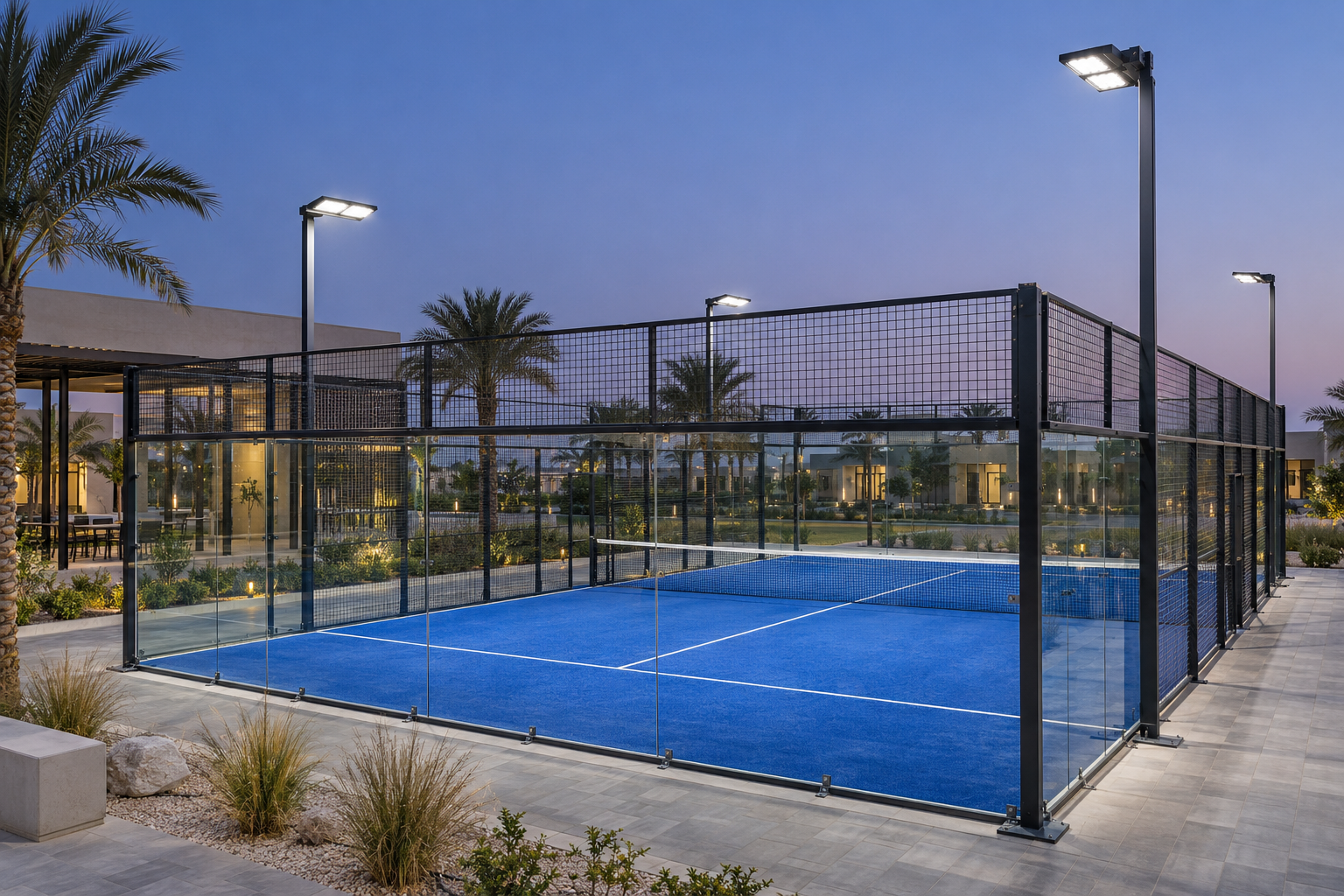
The FIP Rules of Padel, review of application 1 January 2026, Illumination section, page 8 calls for uniform artificial lighting that does not impair the vision of players, officials or spectators, and places light poles outside the court. It also refers readers to court homologation documentation. Confirm the current documents and the conditions applicable to your facility or event with the responsible body; a general buying guide cannot grant that approval.
| Organization / document | Status and scope | Use in the RFQ |
|---|---|---|
| FIP Rules of Padel, review of application 1 January 2026 | Governing-body playing and court guidance; confirm applicable edition and homologation documents | Coordinate lighting, enclosure, pole location and player safety with the court designer |
| ANSI/IES RP-6-24, published 2025 | Recommended practice for sports and recreational lighting; official listing checked, full paid text not reviewed here | Have the lighting designer identify the relevant criteria and methods; no numeric table is reproduced here |
| UAE project authority, venue and event brief | Site-specific approvals and contractual acceptance criteria to be confirmed | Record who accepts the design, installation and final measurements |
A photometric study predicts lighting using the selected fixture's distribution and the modeled site. The IES introduction to photometric files explains that an IES file represents light distribution and is used by lighting calculation software. Ask for the exact order code, optic, output setting and corresponding test data, rather than a simulation for a different member of the product family.
Request a scaled plan showing the enclosure, glass and mesh, obstructions, pole coordinates, mounting heights and aiming schedule. Agree the calculation areas and grid, horizontal plane, any relevant vertical planes, and the player and off-site viewpoints used for glare assessment. Ask the designer to identify the applicable glare method rather than accepting an unexplained comfort score.
Keep initial and maintained results distinct. Initial results describe the declared starting condition; maintained results include the design's stated light-loss assumptions. The report should identify those assumptions, the control state used, and the definitions of average, minimum and uniformity. Every bidder should use the same scope. A supplier rendering is a proposal for review, not evidence that the installed court has passed acceptance.
Ask what the optic, aiming and any proposed shield are intended to change, then review that configuration in the project model. Include views toward high balls and through the glass enclosure in the design review. Check surrounding homes, guest rooms, roads and paths on the plan; do not judge spill from the court's brightness alone.
The DarkSky and IES Five Principles for Responsible Outdoor Lighting, updated September 2026, recommends careful aiming, shielding and controls so light is directed where and when it is needed. Use these as design principles alongside the applicable project rules. They do not establish UAE legal compliance or certify a quoted fixture.
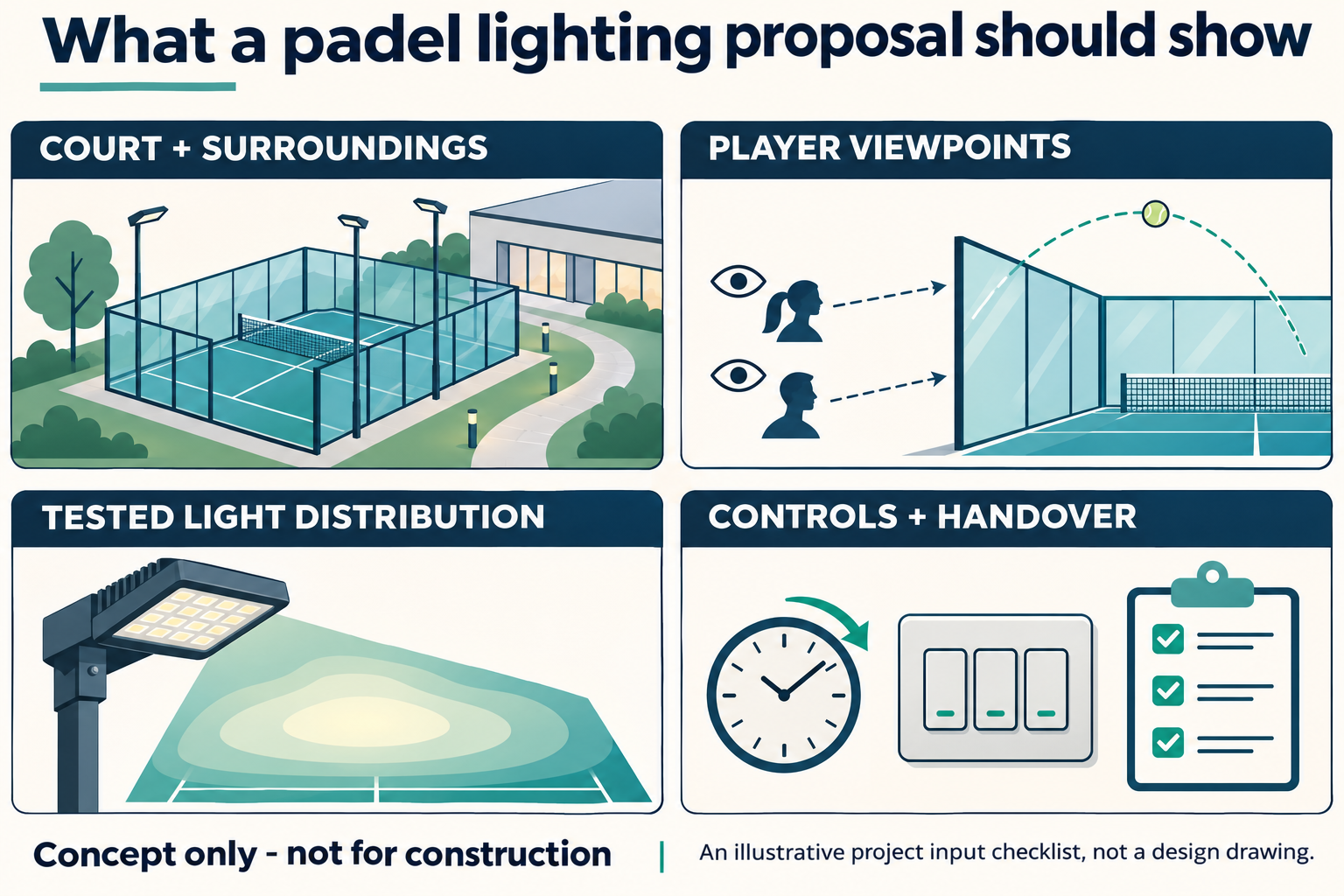
Mark each item as confirmed, clarification needed or not applicable, and name the document that supports the decision. These are buyer review prompts; the responsible designer sets the project acceptance criteria.
| Review item | Evidence to identify | Clarification to request |
|---|---|---|
| Product identity | Order code, optic, output setting and photometric test reference match the quotation and IES file. | A family datasheet or a simulation for a different optic leaves the quoted configuration unverified. |
| Site and aiming | Scaled court and enclosure plan, pole coordinates, mounting heights, luminaire orientation and aiming schedule. | Ask the designer to explain omitted glass, mesh, obstructions and relevant nearby buildings. |
| Calculation planes and grids | Declared horizontal and relevant vertical planes, grid extent and spacing, included points and result rounding. | Return a report whose calculation area or point selection cannot be identified. |
| Average and uniformity | Average and minimum values use the agreed area; the report spells out its uniformity formula and ratio direction. | Minimum/average and maximum/minimum are different ratios. Do not compare unlabeled uniformity figures. |
| Maintained performance | Initial or maintained condition, component light-loss assumptions and the control state used in each calculation. | Request an explanation if competing bids use different maintenance or output assumptions. |
| Glare and boundaries | Applicable glare method, relevant player/observer positions and agreed neighboring-boundary assessment. | A colored illuminance plot alone does not document the declared glare review. |
| Approval and handover | Report revision, responsible reviewer, unresolved exceptions and agreed field-measurement procedure. | Record acceptance of the final revision; a supplier rendering is not an installed measurement. |
Review environmental, structural and electrical evidence alongside the photometric submission. A lighting calculation does not establish the offered fixture's ingress rating, temperature capability, structural suitability or electrical approval. Obtain the exact product evidence and the responsible professionals' review for those matters.
For fixture selection before the report stage, see the Middle East padel and tennis court-light buying guide. The UAE compound court-lighting guide provides broader site context. Compare the Vantone product range with the exact configuration and evidence listed in the reviewed submission.
Put acceptance in the purchase scope: approved product schedule, as-built locations and aiming, programmed controls, agreed measurement procedure, and the person responsible for reviewing results. Request the installation manual, spare-parts list and maintenance plan. Resolve any difference between the approved proposal and the installed system before handover.
What this guide cannot determine: the final wattage, fixture count, pole height, illuminance criteria, local permits, structural suitability or installed result without the project data and responsible design review. A shared RFQ brief makes those decisions visible before commercial comparison.
No. Request the input schedule, tested distribution file, calculation planes and grids, maintained-performance assumptions and relevant glare and boundary review. A plot is one part of the report; it does not document all those decisions.
Only after checking the formula, calculation area, grid, operating state and initial or maintained condition. A minimum-to-average ratio cannot be treated as the same metric as a maximum-to-minimum ratio. Ask for comparable reports before ranking the bids.
Agree the value and measurement scope with the lighting designer, venue, relevant authority and any event organizer. State the document and edition, play class, calculation plane, initial or maintained condition, grid and uniformity definition. This article does not prescribe a universal lux value.
Send the court count and dimensions, CAD or site plan, project location, enclosure details, pole locations and heights, play level, nearby sensitive boundaries, voltage, operating schedule and new-build or retrofit status. Include OEM requirements if relevant and identify the evidence expected with the proposal.
Contact Vantone for a Quick QuoteSend court count and dimensions, CAD or site plan, pole locations and heights, play level, UAE location, nearby boundaries, voltage, operating schedule and new-build or retrofit status.


