


Peruvian pacific port service roads, container lanes, gate approaches, maintenance bays, pedestrian paths, and waterside working areas need exterior lighting that supports safe container handling, truck movement, maintenance work, gate inspection, pedestrian visibility, CCTV performance, and reliable nighttime operations without treating wattage as the only specification. The most dependable projects begin with a site plan, an operating profile, and a practical maintenance approach. That gives buyers a way to compare factory quotations on usable performance rather than on a headline lumen figure alone.
For IP66 LED flood lights for Peruvian ports, the design team should first document the actual project constraints: route dimensions, mounting locations, power availability, site access, nearby buildings, delivery schedule, and commissioning responsibility. Country-level market conditions can help frame the opportunity, but the final lighting design must be based on the local site and the operating tasks that happen after dark.
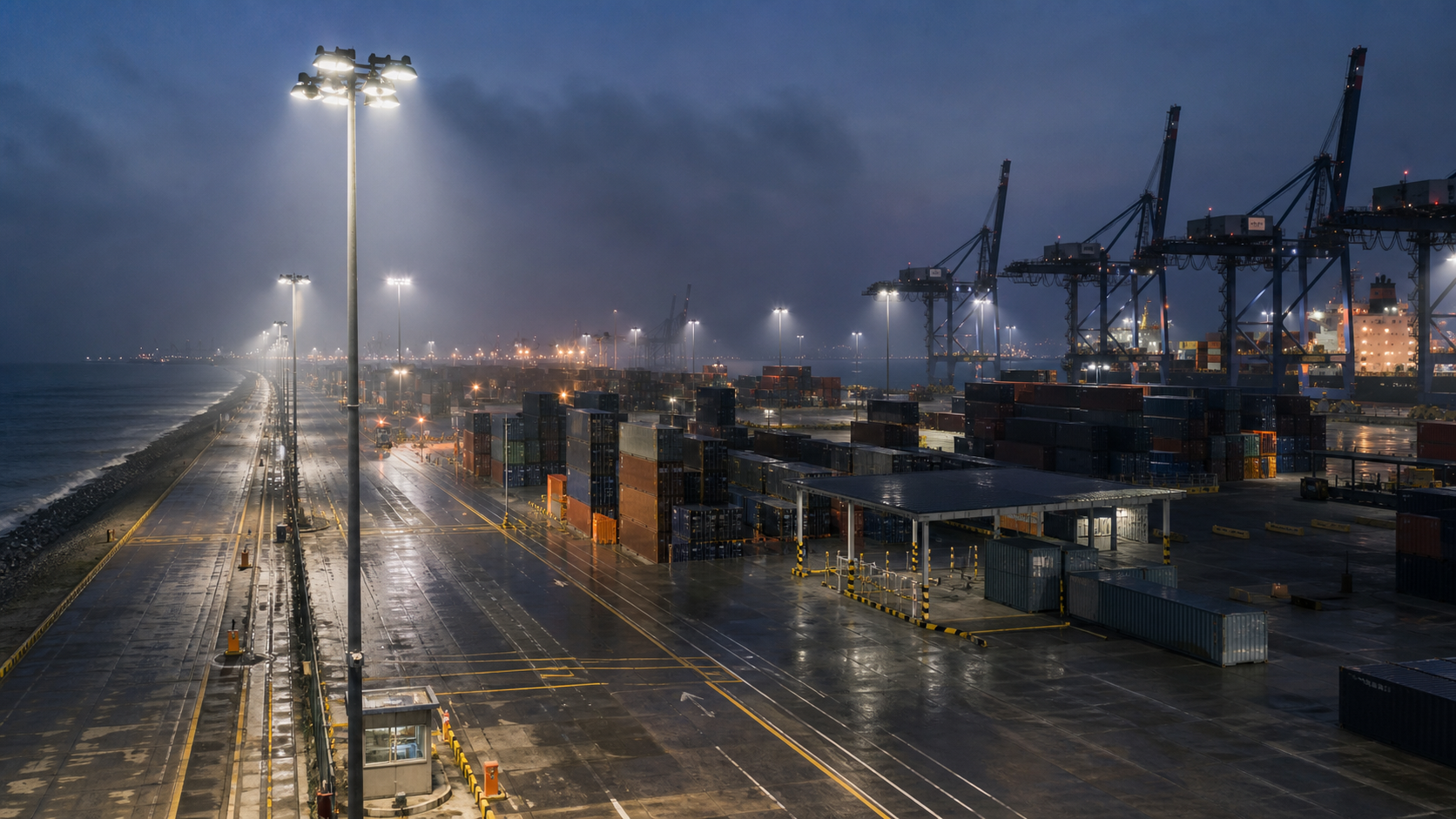
Separate the site into container transfer lanes, gate checkpoints, reefer-service areas, maintenance bays, dockside walkways, equipment parking, and emergency routes. These are different visual tasks, so they should not automatically receive the same beam pattern, mounting height, or operating schedule. A route drawing should identify vehicle paths, pedestrian crossings, equipment clearances, boundaries, camera positions, and places where temporary work can occur. This simple mapping exercise helps the supplier propose optics and pole locations that fit the real operation.
Ask for a basic lighting layout before approving quantity. It should show fixture positions, mounting heights, aiming directions, assumed reflectance, expected average illumination, and uniformity across each critical area. For projects with existing poles or buildings, include photographs and dimensions in the RFQ. A layout is much more useful than a quotation that only lists watts and units.
Buyers should request a clear calculation or selection basis for the available grid voltage, circuit zoning, surge protection, switching schedule, dimming strategy, emergency-operation needs, and the maintenance isolation plan. The system needs to match the hours when people, vehicles, and security teams actually use the site. A staged program can often run brighter at shift changes, loading peaks, or maintenance windows, then reduce output when the route is quiet. This approach protects runtime or energy cost while keeping critical areas visible.
Do not accept vague wording such as “all-night lighting” without the operating assumptions behind it. Specify the target start and end times, any dimming levels, seasonal changes, expected cloudy or low-production periods where relevant, and whether the controller settings can be adjusted after commissioning. Require the supplier to identify what happens if the site expands or the schedule changes.
Outdoor lighting performs best when it puts light on the intended task area instead of creating bright points in driver, operator, guard, or camera sightlines. Use beam distributions, shielding, mounting height, and aiming adjustment to control glare. At entrances and curves, avoid abrupt changes between very bright and dark areas. Near property boundaries or water, use careful aiming to reduce wasted upward and outward light.
For each proposal, ask how the optic supports the intended lane width or work zone. Check visibility from a driver's eye level, from a pedestrian path, and from the nearest CCTV position. A field sample is especially valuable when the project includes reflective pavement, wet surfaces, dust, heavy equipment, or adjacent buildings that may cause bounce light.
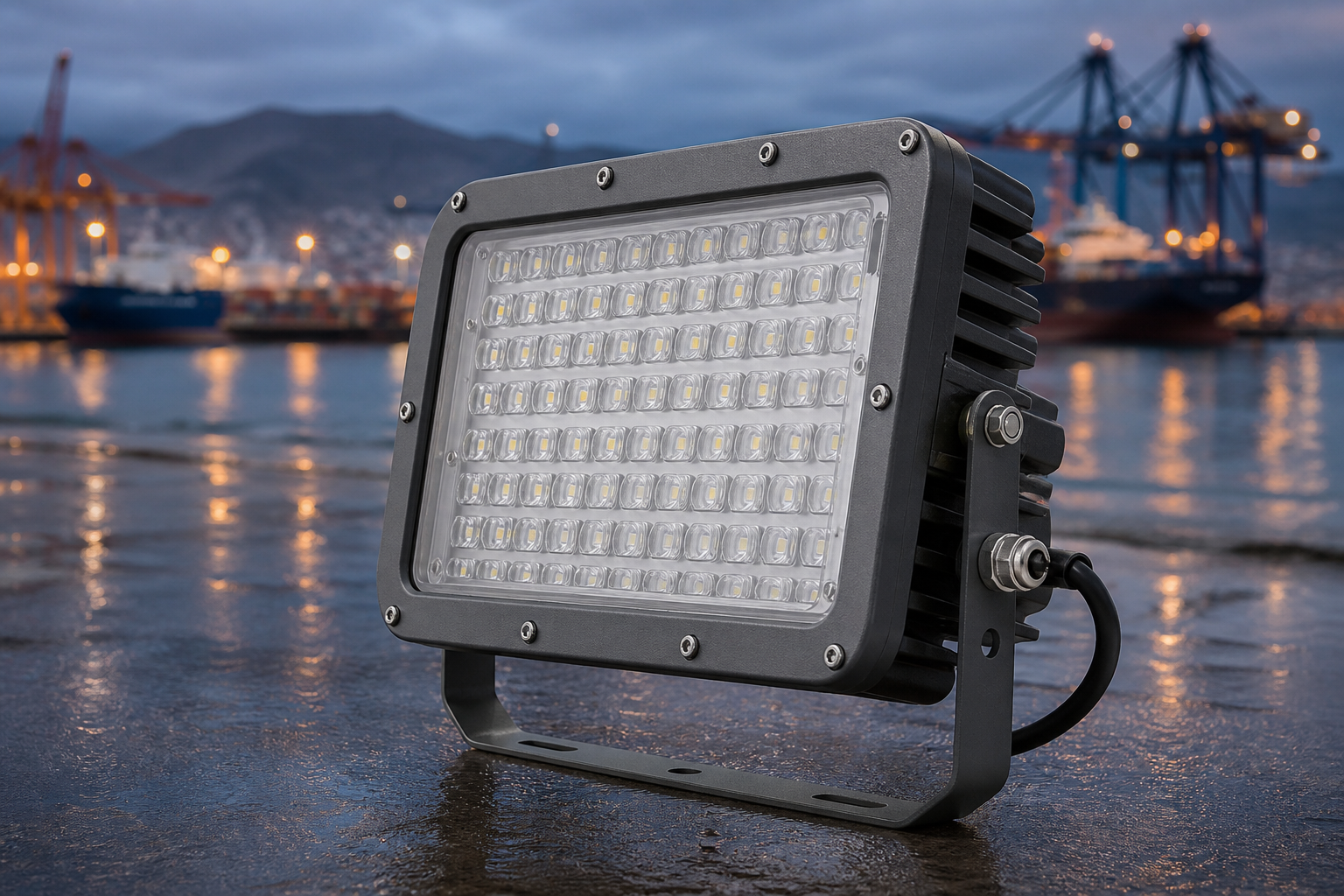
The outdoor construction must suit salt-laden coastal air, humidity, wet pavement, vibration, wind, vehicle exhaust, demanding operating hours, and corrosion exposure. Buyers should compare IP66 sealing, marine-suitable coating, finned die-cast aluminum housing, protected cable gland, stainless or corrosion-resistant fasteners, adjustable yoke brackets, and surge protection. An IP rating is one useful part of the specification, but it should be reviewed together with mounting, cable entry, heat management, fasteners, coating, and the accessibility of replaceable components. The best first-cost option is not always the easiest product to maintain once it is installed on a busy route or high pole.
Request drawings that show bracket adjustment, pole interface, fixture dimensions, cable routing, weight, and recommended installation hardware. Clarify who provides the pole, foundations, wiring, and protective devices. For a large rollout, standardize the approved fixture family, optics, finish, control program, brackets, and spare parts. Consistency makes repeat orders and maintenance much simpler.
Send every bidder the same package: site plan, route widths, target areas, mounting-height limits, electrical or solar requirements, operating schedule, delivery destination, quantity, required certifications, packaging preferences, and OEM needs. Ask each supplier to include a layout, product datasheet, photometric data where available, installation drawing, wiring or controller details, packing method, warranty, sample policy, lead time, and spare-parts policy.
Before bulk production, install a representative pilot area. Check coverage after dark, glare at relevant viewing positions, bracket stability, control operation, camera visibility, cable protection, and the ease of future service. Record the approved aiming angles and programming values. The pilot gives the buyer a repeatable standard for the balance of the project.
Ip66 led flood lights for peruvian ports: IP66 LED flood lights for Peruvian ports are best specified as a controlled outdoor lighting package for container lanes, gate approaches, service roads, maintenance bays, pedestrian paths, and waterside work areas. Buyers should assess optical distribution, mounting, cable protection, corrosion exposure, surge protection, circuit zoning, operating schedule, and maintenance isolation together.
These external sources help buyers frame site research and procurement questions. They do not replace a project-specific lighting design, local code review, or installation assessment.
It should show pole or fixture positions, mounting heights, optic or beam choices, aiming directions, target areas, and the assumed illumination performance. It should also identify boundaries, roads, pedestrian routes, buildings, and any special work zones.
No. A higher wattage can waste energy or create glare if the optic, mounting height, and spacing are wrong. Compare the complete layout, useful light on the task area, uniformity, controls, and serviceability.
Approve a sample or pilot installation, technical drawings, the lighting layout, operating program, fixture finish, mounting arrangement, packaging, warranty, and agreed spare parts. This avoids mismatched components when production begins.
Contact Vantone for a Quick Quote Send project details on WhatsApp: wattage, quantity, mounting height, target area, voltage and OEM requirements.