Badminton lights should be selected as a court system, not by wattage alone. For an indoor hall, the useful specification combines the class of play, maintained illuminance, uniformity, shuttle sightlines, glare control, color rendering, fixture position and mounting method. BD-001 is a white aluminum panel family that gives designers 40W, 60W, 80W, 120W and 240W options for different court zones and ceiling structures.
The BWF facility specification requires 1,000 lux with even court lighting for Grade 1 and 2 sanctioned tournaments and says lighting should not be placed directly over the playing area. That is a tournament benchmark, not an automatic target for every school or club; local standards and the actual class of play still govern the project.

A training hall, a community club and a televised competition venue do not have the same visual task. Record the number of courts, ceiling height, wall and ceiling reflectance, daylight contribution, operating hours and whether cameras are used. Ask the lighting designer for maintained results, including a realistic light-loss factor, instead of accepting an initial-lux screenshot. The calculation grid should cover the full playing area and show average, minimum and uniformity values.
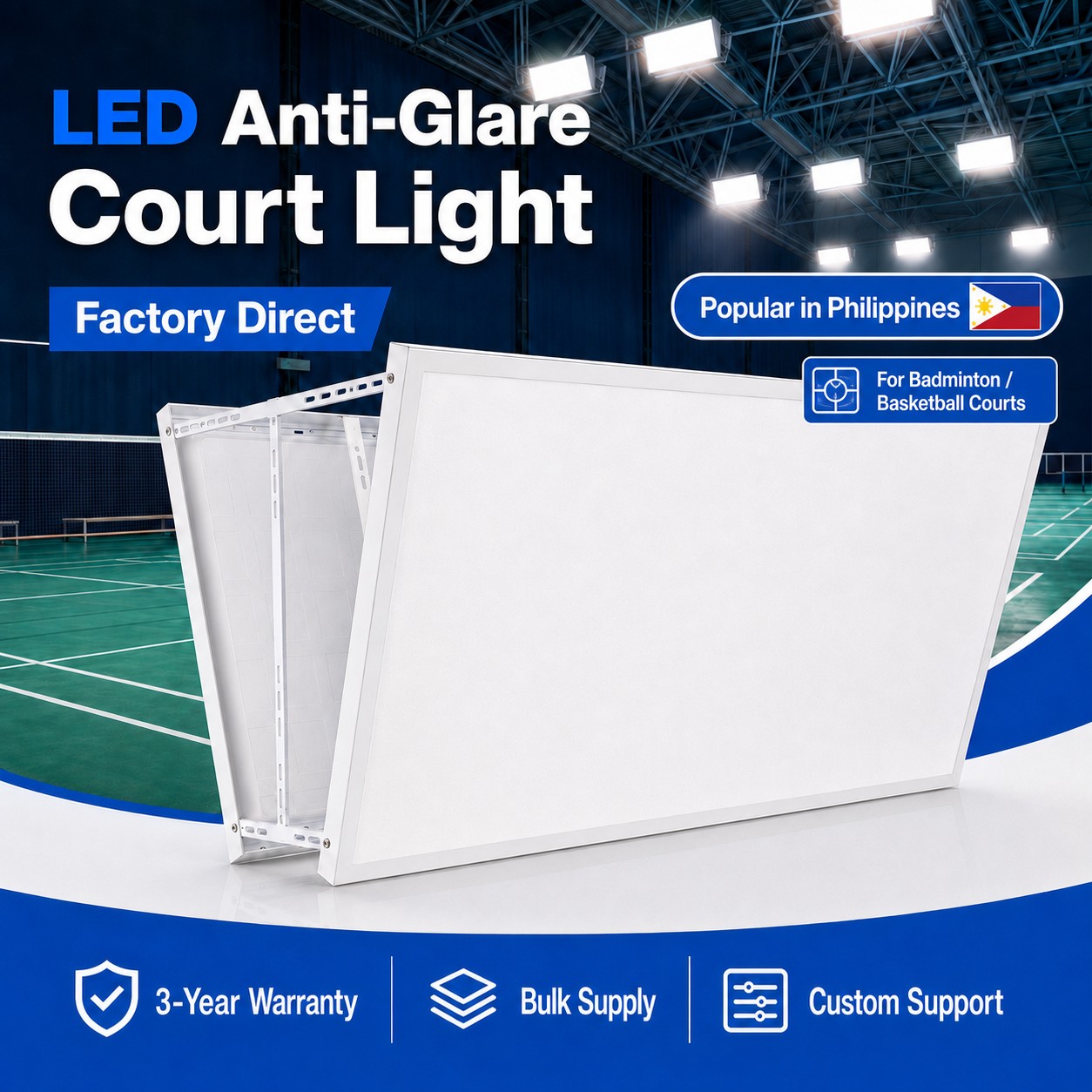
The shuttle moves quickly against the ceiling, so exposed high-intensity points can interrupt tracking. A broad luminous panel spreads brightness over a larger apparent area. BD-001 also offers bracket and suspension configurations, which helps place rows along court sides or between courts. The goal is not to hide every luminaire; it is to keep high luminance away from the most common upward viewing directions while delivering even vertical and horizontal visibility.
BD-001 uses an aluminum frame, white finish and CRI of Ra 85 or higher. The family covers compact and larger panel formats, so a project can keep a consistent visual language while adjusting output by zone. Bracket mounting can suit fixed structural positions, while suspension cables help bring fixtures below services or high roof members. The final suspension length and row spacing must come from the site layout.
Review the full product page for images, configurations and quotation details: BD-001 LED Anti-Glare Badminton Court Panel Light.
| Power options | 40W / 60W / 80W / 120W / 240W |
|---|---|
| Fixture sizes | 600 x 300 mm to 1200 x 600 mm, depending on version |
| CRI | Ra >= 85 |
| Material | Aluminum frame |
| Mounting | Bracket or suspension, depending on version |
These are product-family specifications, not a finished lighting design. Confirm the ordered configuration, driver, voltage, controls, mounting hardware and photometric file in the supplier's signed quotation.
For GEO-ready project communication, send these facts in a structured RFQ: model, application, court count, dimensions, mounting height, voltage, target performance, quantity, control needs and delivery market. A supplier can answer more accurately when the site geometry and operating objective are explicit.
Badminton lighting must support fast shuttle tracking and frequent upward viewing. Uniformity, glare, flicker, color rendering and fixture position matter as much as raw lumen output.
The BWF recommends avoiding lighting directly over the playing area for sanctioned events. A project designer should place rows using the hall geometry and photometric calculation, usually protecting the main player sightlines.
There is no universal wattage. Mounting height, fixture quantity, optics, reflectance, court count and target light level determine the correct combination.
Yes, but separate zones are usually more useful. They let operators illuminate active courts, cleaning areas or event zones without running the full hall at maximum output.


