For sports facilities, outdoor lighting is not only about making a court brighter. Good lighting helps players track the ball, supports safer movement, improves viewing comfort, and reduces complaints from nearby homes or roads. This is why anti-glare outdoor LED sports lighting has become an important procurement topic for schools, clubs, municipalities, contractors, and project distributors.
Market reports continue to show demand for LED sports and stadium lighting, driven by energy efficiency, sports infrastructure upgrades, and lower maintenance compared with older lighting systems. But for B2B buyers, the practical challenge is more specific: how do you choose LED court lights that provide enough brightness without creating uncomfortable glare, hot spots, or wasted spill light?
This guide explains what importers, engineering contractors, wholesalers, and facility buyers should check before buying anti-glare court lights or outdoor LED sports lighting in bulk.
Sports lighting often needs higher brightness than general outdoor area lighting. That creates a common problem: a fixture may deliver strong output but still perform poorly if the light is aimed incorrectly or if the optical design allows glare into players' eyes.
Glare can affect tennis, basketball, pickleball, football training areas, and small stadiums. Players may lose sight of fast-moving balls. Spectators may feel discomfort. Nearby residents may complain about light spill. For contractors, these problems can lead to rework, warranty pressure, and project delays.
Anti-glare lighting is designed to control where light goes. Good optical control directs useful light onto the playing surface and reduces unwanted light toward players, spectators, roads, and neighboring properties.
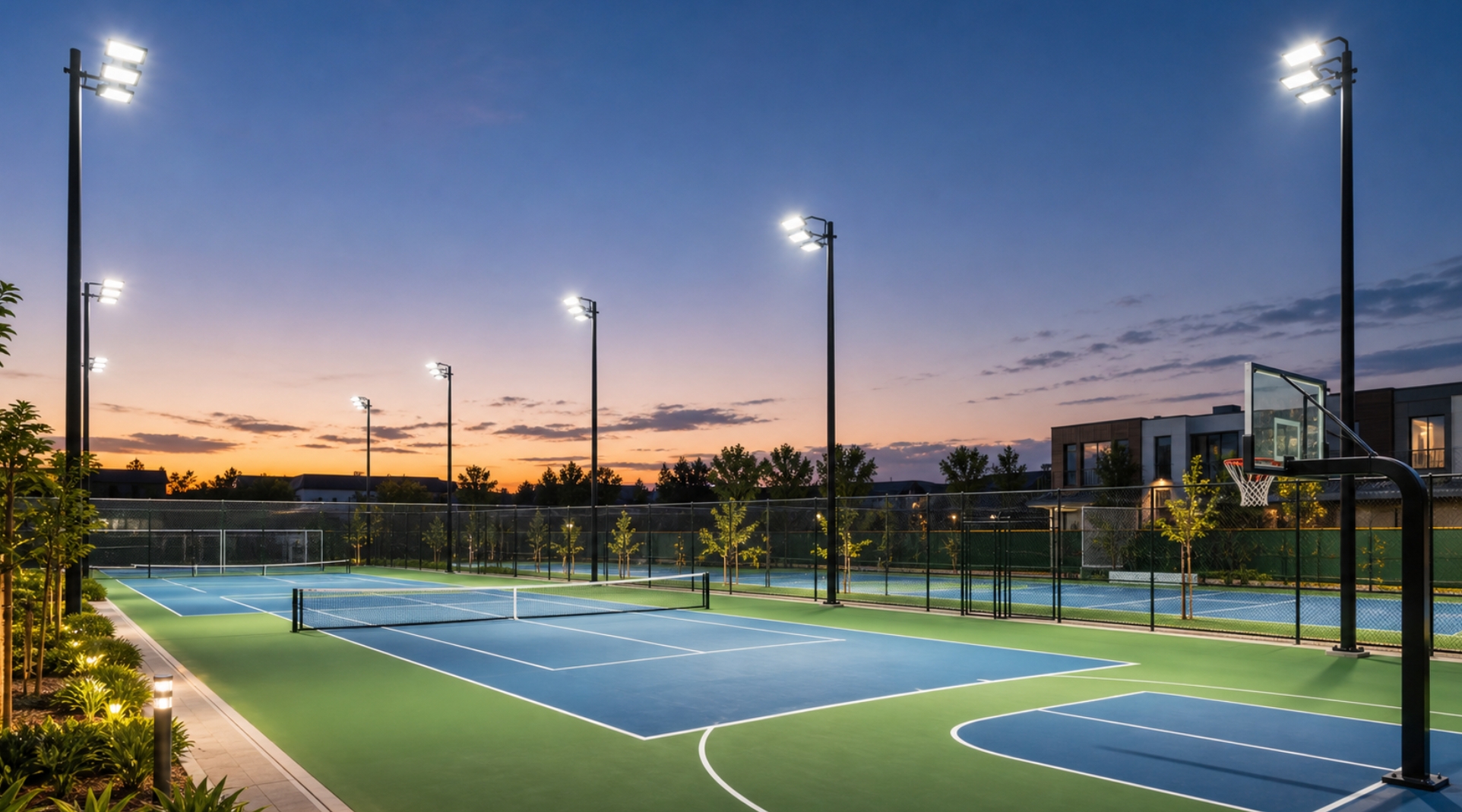
Anti-glare LED sports lighting helps improve court visibility while reducing discomfort for players and nearby areas.
Anti-glare LED sports lights can be used in tennis court lighting, basketball court lighting, pickleball court lighting, school playground lighting, municipal sports court lighting, club recreation areas, small stadium lighting, and industrial park sports zones.
Each application has different design priorities. A recreational basketball court may need cost-effective visibility and simple maintenance. A tennis court needs strong uniformity and low glare because players frequently look upward. A small stadium may require higher output, taller poles, and stronger spill-light control.
The optical system is the heart of an anti-glare court light. Buyers should ask whether the fixture uses lenses, shields, visors, asymmetric distribution, or other controlled optics. The purpose is to place light on the court surface while reducing direct glare.
Uniformity describes how evenly light is distributed across the playing surface. A court with bright spots near the poles and dark areas in the center can be uncomfortable and unsafe even if the average brightness looks acceptable on paper.
LED wattage is only one part of performance. Buyers should compare luminous efficiency, optical loss, beam distribution, heat dissipation, and actual lighting effect.
Outdoor sports lights must handle rain, dust, heat, wind, and long operating hours. IP65 outdoor LED flood lights are commonly used for many outdoor applications, but the complete structure also matters.
Sports lights often run for several hours at high output. If heat is not controlled, LED performance and driver life can decline. A strong aluminum housing, effective heat sink, stable driver, and appropriate installation angle all support better long-term reliability.

A project-grade court light should combine optical control, durable housing, heat dissipation, and outdoor protection.
Even a good fixture can perform badly with the wrong pole layout. Pole height, pole position, beam angle, aiming direction, and fixture quantity should be planned together.
Outdoor LED sports lighting quotations can vary widely because suppliers may use different LED chips, drivers, housings, optics, brackets, and surge protection. To compare quotations fairly, request fixture wattage, lumen output, beam angle, anti-glare design, IP rating, driver specifications, mounting bracket details, lighting layout support, warranty terms, packaging, lead time, and customization options.
For importers and project contractors, buying factory direct LED lighting from China can reduce cost and improve customization flexibility. Buyers should look for technical communication, stable product batches, export packaging, specification documents, and after-sales response.
Guangzhou Vantone Science & Technology Co., Ltd. can position its anti-glare court light and outdoor LED sports lighting products around practical project needs: glare control, waterproof construction, durable mounting, factory-direct customization, and B2B quotation support.
It is sports lighting designed to reduce uncomfortable direct glare while keeping enough useful light on the playing surface.
Use fixtures with controlled optics, choose the correct beam angle, avoid poor aiming, set proper pole height and spacing, and request a lighting layout before bulk purchase or installation.
IP65 is a common protection level for outdoor LED lighting. Buyers should still check housing quality, cable sealing, bracket strength, corrosion resistance, and installation method.
There is no single wattage for every court. The right wattage depends on court size, pole height, target brightness, fixture efficiency, beam angle, and project level.
Need an anti-glare outdoor LED sports lighting solution for courts, schools, clubs, or small stadium projects? Contact Guangzhou Vantone Science & Technology Co., Ltd. for factory direct LED court lights, IP65 outdoor LED sports lighting, and project-based quotation support.


